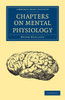
William Carpenter (1813-85) was trained as a doctor; he was apprenticed to an eye surgeon, and later attended University College London and the University of Edinburgh, obtaining his M. D. in 1839. Rather than practising medicine, he became a teacher, specialising in neurology, and it was his work as a zoologist on marine invertebrates that brought him wide scientific recognition. His Principles of Mental Physiology, published in 1874, developed the ideas he had first expounded in the 1850s, and expounds the arguments for and against the two models of psychology then current - automatism, which assumed that the mind operates under the control of the physiology of the body for all human activity, and free will, 'an independent power, controlling and directing that activity.' Drawing on animal as well as human examples, his arguments, especially on the acquisition of mental traits in the individual, are much influenced by Darwin.
This work has been selected by scholars as being culturally important, and is part of the knowledge base of civilization as we know it. This work was reproduced from the original artifact, and...
Originally published in 1834, this book is a classic in the field of physiology and health education. It provides a comprehensive overview of the functions of the human body and their relation to...
The book, The Principles Of Physiology; Applied To The Preservation Of Health, And To The Improvement Of Physical And Mental Education, has been considered by academicians and scholars of great...
This work has been selected by scholars as being culturally important and is part of the knowledge base of civilization as we know it.This work is in the public domain in the United States of...