Trending Bestseller

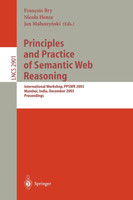
Principles and Practice of Semantic Web Reasoning

International Workshop, PPSWR 2003, Mumbai, India, December 8, 2003, Proceedings

Nicola Henze

No reviews yet Write a Review
Paperback / softback
25 November 2003
$92.00
Ships in 5–7 business days
Hurry up! Current stock:
The Semantic Web is a major endeavor aimed at enriching the existing Web withmetadataandprocessingmethodssoastoprovideWeb-basedsystemswith advanced(so-calledintelligent)capabilities,inparticularwithcontext-awareness and decision support. The advanced capabilities striven for in most Semantic Web application s- narios primarily call for reasoning. Reasoning capabilities are o?ered by exi- ing Semantic Web languages, such as BPEL4WS, BPML, ConsVISor, DAML-S, JTP, TRIPLE, and others. These languages, however, were developed mostly from functionality-centered (e.g., ontology reasoning or access validation) or application-centered (e.g., Web service retrieval and composition) perspectives. A perspective centered on the reasoning techniques (e.g., forward or backward chaining, tableau-like methods, constraint reasoning, etc.) complementing the above-mentioned activities appears desirable for Semantic Web systems and - plications. The workshop on "Principles and Practice of Semantic Web Reas- ing," which took place on December 8, 2003, in Mumbai, India, was the ?rst of a series of scienti?c meetings devoted to such a perspective. JustasthecurrentWebisinherentlyheterogeneousindataformatsanddata semantics, the Semantic Web will be inherently heterogeneous in its reasoning forms.Indeed,anysingleformof reasoningturnsouttobeirrealin theSemantic Web. For example, ontology reasoning in general relies on monotonic negation (for the metadata often can be fully speci?ed), while databases, Web databases, and Web-based information systems call for non-monotonic reasoning (for one would not specify non-existing trains in a railway timetable); constraint reas- ing is needed when dealing with time (for time intervals have to be dealt with), while(forwardand/orbackward)chainingisthereasoningofchoicewhencoping with database-like views (for views, i.e., virtual data, can be derived from actual data using operations such as join and projections).

This product hasn't received any reviews yet. Be the first to review this product!

$92.00
Ships in 5–7 business days
Hurry up! Current stock:

Principles and Practice of Semantic Web Reasoning

$92.00

Description

The Semantic Web is a major endeavor aimed at enriching the existing Web withmetadataandprocessingmethodssoastoprovideWeb-basedsystemswith advanced(so-calledintelligent)capabilities,inparticularwithcontext-awareness and decision support. The advanced capabilities striven for in most Semantic Web application s- narios primarily call for reasoning. Reasoning capabilities are o?ered by exi- ing Semantic Web languages, such as BPEL4WS, BPML, ConsVISor, DAML-S, JTP, TRIPLE, and others. These languages, however, were developed mostly from functionality-centered (e.g., ontology reasoning or access validation) or application-centered (e.g., Web service retrieval and composition) perspectives. A perspective centered on the reasoning techniques (e.g., forward or backward chaining, tableau-like methods, constraint reasoning, etc.) complementing the above-mentioned activities appears desirable for Semantic Web systems and - plications. The workshop on "Principles and Practice of Semantic Web Reas- ing," which took place on December 8, 2003, in Mumbai, India, was the ?rst of a series of scienti?c meetings devoted to such a perspective. JustasthecurrentWebisinherentlyheterogeneousindataformatsanddata semantics, the Semantic Web will be inherently heterogeneous in its reasoning forms.Indeed,anysingleformof reasoningturnsouttobeirrealin theSemantic Web. For example, ontology reasoning in general relies on monotonic negation (for the metadata often can be fully speci?ed), while databases, Web databases, and Web-based information systems call for non-monotonic reasoning (for one would not specify non-existing trains in a railway timetable); constraint reas- ing is needed when dealing with time (for time intervals have to be dealt with), while(forwardand/orbackward)chainingisthereasoningofchoicewhencoping with database-like views (for views, i.e., virtual data, can be derived from actual data using operations such as join and projections).

Customers Also Viewed

Buy Books Online at BookLoop

Discover your next great read at BookLoop, Australiand online bookstore offering a vast selection of titles across various genres and interests. Whether you're curious about what's trending or searching for graphic novels that captivate, thrilling crime and mystery fiction, or exhilarating action and adventure stories, our curated collections have something for every reader. Delve into imaginative fantasy worlds or explore the realms of science fiction that challenge the boundaries of reality. Fans of contemporary narratives will find compelling stories in our contemporary fiction section. Embark on epic journeys with our fantasy and science fiction titles,

Shop Trending Books and New Releases

Explore our new releases for the most recent additions in romance books, fantasy books, graphic novels, crime and mystery books, science fiction books as well as biographies, cookbooks, self help books, tarot cards, fortunetelling and much more. With titles covering current trends, booktok and bookstagram recommendations, and emerging authors, BookLoop remains your go-to local australian bookstore for buying books online across all book genres.

Shop Best Books By Collection

Stay updated with the literary world by browsing our trending books, featuring the latest bestsellers and critically acclaimed works. Explore titles from popular brands like Minecraft, Pokemon, Star Wars, Bluey, Lonely Planet, ABIA award winners, Peppa Pig, and our specialised collection of ADHD books. At BookLoop, we are committed to providing a diverse and enriching reading experience for all.