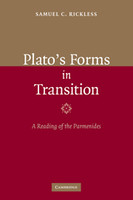
There is a mystery at the heart of Plato's Parmenides. In the first part, Parmenides criticizes what is widely regarded as Plato's mature theory of Forms, and in the second, he promises to explain how the Forms can be saved from these criticisms. Ever since the dialogue was written, scholars have struggled to determine how the two parts of the work fit together. Did Plato mean us to abandon, keep or modify the theory of Forms, on the strength of Parmenides' criticisms? Samuel Rickless offers something that has never been done before: a careful reconstruction of every argument in the dialogue. He concludes that Plato's main aim was to argue that the theory of Forms should be modified by allowing that forms can have contrary properties. To grasp this is to solve the mystery of the Parmenides and understand its crucial role in Plato's philosophical development.
Plato on Knowledge and Forms brings together a set of connected essays by Fine, written over a period of twenty-five years, on Plato's metaphysics and epistemology. It also includes a previously...
A comprehensive study of Plato's philosophy of transition, exploring his views on change, transformation, and the nature of reality. Drawing on a wide range of Platonic dialogues, this book offers a...