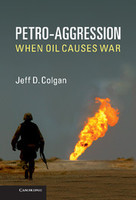
Oil is the world's single most important commodity and its political effects are pervasive. Jeff D. Colgan extends the idea of the resource curse into the realm of international relations, exploring how countries form their foreign policy preferences and intentions. Why are some but not all oil-exporting 'petrostates' aggressive? To answer this question, a theory of aggressive foreign policy preferences is developed and then tested, using both quantitative and qualitative methods. Petro-Aggression shows that oil creates incentives that increase a petrostate's aggression, but also incentives for the opposite. The net effect depends critically on its domestic politics, especially the preferences of its leader. Revolutionary leaders are especially significant. Using case studies including Iraq, Iran, Libya, Saudi Arabia and Venezuela, this book offers new insight into why oil politics has a central role in global peace and conflict.
It is a work of a superhero who emerges from lightning, he emerges in the year zero and becomes friends with Xotz, Petro's hometown, thus devastated and Petro takes revenge, but sadness makes him...
Hakuna mtu anayejua maisha ya Kristo anahitaji uanzisho wowote kwa Petro - Petro, aliyejaa matumaini na waraka huu inaelezea tabia yake. Neno ka huhimu ni matumaini (1 Petro 1: 3). Tukio la waraka ni...
"Because Chavez is breaking all of the rules, we are all struggling to be better informed about what he is up to and how to interpret his actions at home and abroad. Each of the essays sheds...
Petros, a Greek Immigrant, comes to America in the very early nineteen hundreds to start a new life. The story follows him from New York and his chance contact with Don Lucasio, a powerful man; to...
This concise edition of the biography of Walatta-Petros (1672) tells the story of an Ethiopian saint who lived from 1592 to 1642 and led a successful nonviolent movement to preserve African Christian...