Since the 1980s, political scientists have developed a renewed interest in the study of political institutions, based on the assumption that "institutions matter" -that is, that formal governmental institutions and constitutional-legal rules (as well as informal institutions like parties and interest groups) are crucial determinants of the shape of politics and policy outcomes. In this respect, the "new institutionalism" resembles the "old institutionalism" of pre-behaviorist days, but the crucial difference between the two is that the new institutionalists are committed to systematic empirical testing of their hypotheses, at least in principle. In practice, however, especially in compara tive analyses, this goal has often been frustrated by the lack of reliable data for a large number of countries. Researchers have therefore usually been limited to testing their hypotheses with modest data sets collected for their own particular purposes. Of all of the political institutions, the executive branch of the government is by far the most important; it can be regarded as the irreducible core of government and the principal embodiment of political authority with specific powers that are not lodged elsewhere in the political system. Almost all countries in the world, and certainly all modem democracies, have an executive body called "government", "cabinet", or "administration" (as in the term "the Clinton administration") that has the main responsibility for running the country's public affairs.
Since the 1980s, political scientists have developed a renewed interest in the study of political institutions, based on the assumption that "institutions matter" -that is, that formal governmental institutions and constitutional-legal rules (as well as informal institutions like parties and interest groups) are crucial determinants of the shape of politics and policy outcomes. In this respect, the "new institutionalism" resembles the "old institutionalism" of pre-behaviorist days, but the crucial difference between the two is that the new institutionalists are committed to systematic empirical testing of their hypotheses, at least in principle. In practice, however, especially in compara tive analyses, this goal has often been frustrated by the lack of reliable data for a large number of countries. Researchers have therefore usually been limited to testing their hypotheses with modest data sets collected for their own particular purposes. Of all of the political institutions, the executive branch of the government is by far the most important; it can be regarded as the irreducible core of government and the principal embodiment of political authority with specific powers that are not lodged elsewhere in the political system. Almost all countries in the world, and certainly all modem democracies, have an executive body called "government", "cabinet", or "administration" (as in the term "the Clinton administration") that has the main responsibility for running the country's public affairs.
Given the centrality of political parties in modern democracies, most research on these systems either directly address their internal functioning and activities or question their critical role...
Party Patronage and Party Government in European Democracies brings together insights from the worlds of party politics and public administration in order to analyze the role of political parties in...
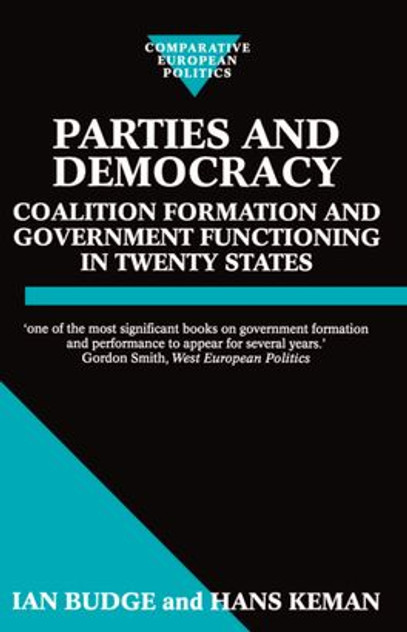
This book studies the actual behaviour of some four hundred governments in twenty post-war democracies, including those of Western Europe, Australia, Israel, Japan, and New Zealand. Its conclusion...
This is a reproduction of a book published before 1923. This book may have occasional imperfections such as missing or blurred pages, poor pictures, errant marks, etc. that were either part of the...
Discover your next great read at BookLoop, Australiand online bookstore offering a vast selection of titles across various genres and interests. Whether you're curious about what's trending or searching for graphic novels that captivate, thrilling crime and mystery fiction, or exhilarating action and adventure stories, our curated collections have something for every reader. Delve into imaginative fantasy worlds or explore the realms of science fiction that challenge the boundaries of reality. Fans of contemporary narratives will find compelling stories in our contemporary fiction section. Embark on epic journeys with our fantasy and science fiction titles,
Shop Trending Books and New Releases
Explore our new releases for the most recent additions in romance books, fantasy books, graphic novels, crime and mystery books, science fiction books as well as biographies, cookbooks, self help books, tarot cards, fortunetelling and much more. With titles covering current trends, booktok and bookstagram recommendations, and emerging authors, BookLoop remains your go-to local australian bookstore for buying books online across all book genres.
Shop Best Books By Collection
Stay updated with the literary world by browsing our trending books, featuring the latest bestsellers and critically acclaimed works. Explore titles from popular brands like Minecraft, Pokemon, Star Wars, Bluey, Lonely Planet, ABIA award winners, Peppa Pig, and our specialised collection of ADHD books. At BookLoop, we are committed to providing a diverse and enriching reading experience for all.
Sign In
your cart
Your cart is empty
Menu
Search
PRE-SALES
If you have any questions before making a purchase chat with our online operators to get more information.