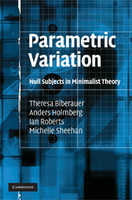
Parametric variation in linguistic theory refers to the systematic grammatical variation permitted by the human language faculty. Although still widely assumed, the parametric theory of variation has in recent years been subject to re-evaluation and critique. The Null Subject Parameter, which determines among other things whether or not a language allows the suppression of subject pronouns, is one of the best-known and most widely discussed examples of a parameter. Nevertheless its status in current syntactic theory is highly controversial. This book is a defence of the parametric approach to linguistic variation, set within the framework of the Minimalist Program. It discusses syntactic variation in the light of recent developments in linguistic theory, focusing on issues such as the formal nature of minimalist parameters, the typology of null-subject language systems and the way in which parametric choices can be seen to underlie the synchronic and diachronic patterns observed in natural languages.
In this outstanding collection of new work the methods and theories of formal syntax are focussed on grammatical variation and change. The editors open the volume with an extensive and accessible...
This book explores the idea that functional categories are the flesh and blood of grammar'. From within the context of the Principles and Parameters framework put forward by Chomsky and others,...
Weak convergence is a basic tool of modern nonlinear analysis because it enjoys the same compactness properties that finite dimensional spaces do: basically, bounded sequences are weak relatively...