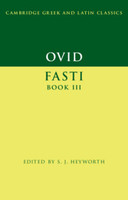

Ovid is now firmly established as a central figure in the Latin poetic canon, and his Fasti is his most complex elegy. Drafted alongside the Metamorphoses before the poet's exile, it was only published after the death of Augustus, and involves a wide range of myth, Roman history, religion, astronomy and explication of the calendar. In its aetiology and conversations with gods, it is a Latin equivalent of Callimachus' Aetia. This invaluable new commentary on a central book of the poem explores Ovid's playful inversion of genre, his witty but challenging style of Latin, his use of the elegiac couplet, intertextuality and much more. With a comprehensive introduction providing key background for students and instructors, this guide to Book 3, the first in English for nearly a century, makes use of the latest scholarly research to illuminate Ovid's wide-ranging and amusing account of Roman life.
This work has been selected by scholars as being culturally important, and is part of the knowledge base of civilization as we know it. This work was reproduced from the original artifact, and...
Dr Brown's new research illuminates the Fasti (Ovid's poetical calendar of the Roman year, of AD 4-16) as a unique contemporary source for our understanding of the politics and culture of the...
This ground-breaking book celebrates the bimillennial anniversary of the inception of Ovid's Fasti by offering a variety of approaches to Ovid's poem on the Roman religious calendar. It is edited by...