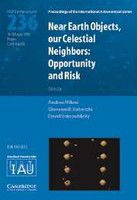

Near Earth Objects, our Celestial Neighbors (IAU S236)
Near Earth Objects (NEOs), asteroids and comets, are the closest neighbors of the Earth-Moon system. They allow research not yet possible on more distant bodies. The IAU Symposium 236 focused on the specific observation and modeling techniques for NEOs, including radar, exploration by spacecraft, measurement of non-gravitational perturbations; also on the next generation surveys expected to increase a hundred-fold the NEO discovery rate. With data from first generation NEO surveys, we now understand how they formed and evolve, dynamically and physically, opening a window on the universal astrophysical phenomenon of collision, leaving clear markings on the surfaces of planets, including the Earth. NEOs with orbits crossing that of the Earth are also a source of impact risks and potential NEO collisions with the Earth represent a long term threat. Mankind has to put in place a chain of mitigating actions; NEO astronomers have successfully put in place the first link.
Celestial Objects is the definitive guide to the stars, planets, and other heavenly bodies. Featuring stunning photographs, detailed descriptions, and helpful tips on observing the night sky, this...
CELESTIAL EARTH is an investigation into the extraordinary 'transitional age' tha Humanity and the Earth are both experiencing in the present historical moment. Some of the issues presented: The...
""A Cycle of Celestial Objects: Observed, Reduced and Discussed"" is a book written by William Henry Smyth and first published in 1881. The book is a collection of Smyth's observations of various...