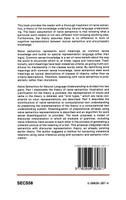
This book introduces a theory, Naive Semantics (NS), a theory of the knowledge underlying natural language understanding. The basic assumption of NS is that knowing what a word means is not very different from knowing anything else, so that there is no difference in form of cognitive representation between lexical semantics and ency clopedic knowledge. NS represents word meanings as commonsense knowledge, and builds no special representation language (other than elements of first-order logic). The idea of teaching computers common sense knowledge originated with McCarthy and Hayes (1969), and has been extended by a number of researchers (Hobbs and Moore, 1985, Lenat et aI, 1986). Commonsense knowledge is a set of naive beliefs, at times vague and inaccurate, about the way the world is structured. Traditionally, word meanings have been viewed as criterial, as giving truth conditions for membership in the classes words name. The theory of NS, in identifying word meanings with commonsense knowledge, sees word meanings as typical descriptions of classes of objects, rather than as criterial descriptions. Therefore, reasoning with NS represen tations is probabilistic rather than monotonic. This book is divided into two parts. Part I elaborates the theory of Naive Semantics. Chapter 1 illustrates and justifies the theory. Chapter 2 details the representation of nouns in the theory, and Chapter 4 the verbs, originally published as "Commonsense Reasoning with Verbs" (McDowell and Dahlgren, 1987). Chapter 3 describes kind types, which are naive constraints on noun representations.
Naive Semantics for Natural Language Understanding
RRP:
$270.00
Description
This book introduces a theory, Naive Semantics (NS), a theory of the knowledge underlying natural language understanding. The basic assumption of NS is that knowing what a word means is not very different from knowing anything else, so that there is no difference in form of cognitive representation between lexical semantics and ency clopedic knowledge. NS represents word meanings as commonsense knowledge, and builds no special representation language (other than elements of first-order logic). The idea of teaching computers common sense knowledge originated with McCarthy and Hayes (1969), and has been extended by a number of researchers (Hobbs and Moore, 1985, Lenat et aI, 1986). Commonsense knowledge is a set of naive beliefs, at times vague and inaccurate, about the way the world is structured. Traditionally, word meanings have been viewed as criterial, as giving truth conditions for membership in the classes words name. The theory of NS, in identifying word meanings with commonsense knowledge, sees word meanings as typical descriptions of classes of objects, rather than as criterial descriptions. Therefore, reasoning with NS represen tations is probabilistic rather than monotonic. This book is divided into two parts. Part I elaborates the theory of Naive Semantics. Chapter 1 illustrates and justifies the theory. Chapter 2 details the representation of nouns in the theory, and Chapter 4 the verbs, originally published as "Commonsense Reasoning with Verbs" (McDowell and Dahlgren, 1987). Chapter 3 describes kind types, which are naive constraints on noun representations.
Natural Language Semantics discusses fundamental concepts for linguistic semantics. This book combines theoretical explanations of several methods of inquiry with detailed semantic analysis and...
In the spring of 1978, one of the authors of this book was sitting in on a course in logic for linguists given by the other author. In attempting to present some of Montague's insights in an...
Discover your next great read at BookLoop, Australiand online bookstore offering a vast selection of titles across various genres and interests. Whether you're curious about what's trending or searching for graphic novels that captivate, thrilling crime and mystery fiction, or exhilarating action and adventure stories, our curated collections have something for every reader. Delve into imaginative fantasy worlds or explore the realms of science fiction that challenge the boundaries of reality. Fans of contemporary narratives will find compelling stories in our contemporary fiction section. Embark on epic journeys with our fantasy and science fiction titles,
Shop Trending Books and New Releases
Explore our new releases for the most recent additions in romance books, fantasy books, graphic novels, crime and mystery books, science fiction books as well as biographies, cookbooks, self help books, tarot cards, fortunetelling and much more. With titles covering current trends, booktok and bookstagram recommendations, and emerging authors, BookLoop remains your go-to local australian bookstore for buying books online across all book genres.
Shop Best Books By Collection
Stay updated with the literary world by browsing our trending books, featuring the latest bestsellers and critically acclaimed works. Explore titles from popular brands like Minecraft, Pokemon, Star Wars, Bluey, Lonely Planet, ABIA award winners, Peppa Pig, and our specialised collection of ADHD books. At BookLoop, we are committed to providing a diverse and enriching reading experience for all.
Sign In
your cart
Your cart is empty
Menu
Search
PRE-SALES
If you have any questions before making a purchase chat with our online operators to get more information.