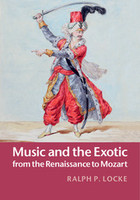
Music and the Exotic from the Renaissance to Mozart
During the years 1500-1800, European performing arts reveled in a kaleidoscope of Otherness: Middle-Eastern harem women, fortune-telling Spanish 'Gypsies', Incan priests, Barbary pirates, moresca dancers, and more. In this prequel to his 2009 book Musical Exoticism, Ralph P. Locke explores how exotic locales and their inhabitants were characterized in musical genres ranging from instrumental pieces and popular songs to oratorios, ballets, and operas. Locke's study offers new insights into much-loved masterworks by composers such as Cavalli, Lully, Purcell, Rameau, Handel, Vivaldi, Gluck, and Mozart. In these works, evocations of ethnic and cultural Otherness often mingle attraction with envy or fear, and some pieces were understood at the time as commenting on conditions in Europe itself. Locke's accessible study, which includes numerous musical examples and rare illustrations, will be of interest to anyone who is intrigued by the relationship between music and cultural history, and by the challenges of cross-cultural (mis)understanding.
Great music arouses wonder: how did the composer create such an original work of art? What was the artist's inspiration, and how did that idea become a reality? Cultural products inevitably arise...
Mozart's emergence as a mature artist coincides with the rise to prominence of the piano, an instrument that came alive under his fingers and served as medium for many of his finest compositions...
This work has been selected by scholars as being culturally important and is part of the knowledge base of civilization as we know it.This work is in the public domain in the United States of...