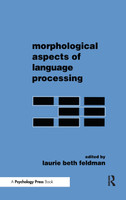
It is now well established that phonological -- and orthographic -- codes play a crucial role in the recognition of isolated words and in understanding the sequences of words that comprise a sentence. However, words and sentences are organized with respect to morphological as well as phonological components. It is thus unfortunate that the morpheme has received relatively little attention in the experimental literature, either from psychologists or linguists. Due to recent methodological developments, however, now is an opportune time to address morphological issues. In the experimental literature, there is a tendency to examine various psycholinguistic processes in English and then to assume that the account given applies with equal significance to English and to other languages. Written languages differ, however, in the extent to which they capture phonological as contrasted with morphological units. Moreover, with respect to the morpheme, languages differ in the principle by which morphemes are connected to form new words. This volume focuses on morphological processes in word recognition and reading with an eye toward comparing morphological processes with orthographic and phonological processes. Cross-language comparisons are examined as a tool with which to probe universal linguistic processes, and a variety of research methodologies are described. Because it makes the experimental literature in languages other than English more accessible, this book is expected to be of interest to many readers. It also directs attention to the subject of language processing in general -- an issue which is of central interest to cognitive psychologists and linguists as well as educators and clinicians.
It is now well established that phonological -- and orthographic -- codes play a crucial role in the recognition of isolated words and in understanding the sequences of words that comprise a sentence. However, words and sentences are organized with respect to morphological as well as phonological components. It is thus unfortunate that the morpheme has received relatively little attention in the experimental literature, either from psychologists or linguists. Due to recent methodological developments, however, now is an opportune time to address morphological issues. In the experimental literature, there is a tendency to examine various psycholinguistic processes in English and then to assume that the account given applies with equal significance to English and to other languages. Written languages differ, however, in the extent to which they capture phonological as contrasted with morphological units. Moreover, with respect to the morpheme, languages differ in the principle by which morphemes are connected to form new words. This volume focuses on morphological processes in word recognition and reading with an eye toward comparing morphological processes with orthographic and phonological processes. Cross-language comparisons are examined as a tool with which to probe universal linguistic processes, and a variety of research methodologies are described. Because it makes the experimental literature in languages other than English more accessible, this book is expected to be of interest to many readers. It also directs attention to the subject of language processing in general -- an issue which is of central interest to cognitive psychologists and linguists as well as educators and clinicians.
This book deals with the conditions and the consequences of the production of different syntactic sentence structures. During the sixties the syntactic structure of sentences was one of the most...
This is a reproduction of a book published before 1923. This book may have occasional imperfections such as missing or blurred pages, poor pictures, errant marks, etc. that were either part of the...
The Third International Conference on Lymphatic Tissue and Germinal Centers in Immune Reactions was held at the University of Uppsala in Sweden, September 1-4, 1970. The conference is obliged to...
This work has been selected by scholars as being culturally important, and is part of the knowledge base of civilization as we know it.This work is in the "public domain in the United States of...
This work has been selected by scholars as being culturally important, and is part of the knowledge base of civilization as we know it.This work is in the "public domain in the United States of...
Discover your next great read at BookLoop, Australiand online bookstore offering a vast selection of titles across various genres and interests. Whether you're curious about what's trending or searching for graphic novels that captivate, thrilling crime and mystery fiction, or exhilarating action and adventure stories, our curated collections have something for every reader. Delve into imaginative fantasy worlds or explore the realms of science fiction that challenge the boundaries of reality. Fans of contemporary narratives will find compelling stories in our contemporary fiction section. Embark on epic journeys with our fantasy and science fiction titles,
Shop Trending Books and New Releases
Explore our new releases for the most recent additions in romance books, fantasy books, graphic novels, crime and mystery books, science fiction books as well as biographies, cookbooks, self help books, tarot cards, fortunetelling and much more. With titles covering current trends, booktok and bookstagram recommendations, and emerging authors, BookLoop remains your go-to local australian bookstore for buying books online across all book genres.
Shop Best Books By Collection
Stay updated with the literary world by browsing our trending books, featuring the latest bestsellers and critically acclaimed works. Explore titles from popular brands like Minecraft, Pokemon, Star Wars, Bluey, Lonely Planet, ABIA award winners, Peppa Pig, and our specialised collection of ADHD books. At BookLoop, we are committed to providing a diverse and enriching reading experience for all.
Sign In
your cart
Your cart is empty
Menu
Search
PRE-SALES
If you have any questions before making a purchase chat with our online operators to get more information.