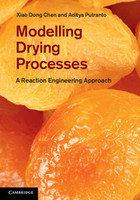
This comprehensive summary of the state of the art and the ideas behind the reaction engineering approach (REA) to drying processes is an ideal resource for researchers, academics and industry practitioners. Starting with the formulation, modelling and applications of the lumped-REA, it goes on to detail the use of the REA to describe local evaporation and condensation, and its coupling with equations of conservation of heat and mass transfer, called the spatial-REA, to model non-equilibrium multiphase drying. Finally, it summarises other established drying models, discussing their features, limitations and comparisons with the REA. Application examples featured throughout help fine-tune the models and implement them for process design and the evaluation of existing drying processes and product quality during drying. Further uses of the principles of REA are demonstrated, including computational fluid dynamics-based modelling, and further expanded to model other simultaneous heat and mass transfer processes.
This book presents a thorough theoretical research of a spray drying process, performed by the author in the framework of his Ph.D. study at Ben-Gurion University of the Negev, Israel, under the...
This book introduces and explains all existing dry processing methods, drawing from larges studies about these techniques in both the academia and industrial sectors. Potentially, water insufficiency...
A comprehensive approach to selecting and understanding drying equipment for chemical and mechanical engineers A detailed reference of interest for engineers and energy specialists working in the...
The dry collodion process was a revolutionary photographic technique that allowed for the creation of high-quality images on a variety of surfaces, including glass and metal. In this thorough and...
The Dry Collodion Process, written by Charles A. Long and first published in 1857, is a comprehensive guide to the photographic technique known as the dry collodion process. This process was a...