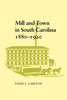
Probing the social repercussions of the industrial development of South Carolina in the decades following Reconstruction, David L. Carlton's Mill and Town in South Carolina, 1880-1920, tells of the conflict that erupted between the rising middle class of the South's small towns and the rural white who came to labor in the towns' burgeoning textile mills. The townsmen who built the mills initially expected no social friction to result from industrialization, since the work force was to consist entirely of white "Anglo-Saxons" like themselves. However, as thousands of rural whites moved into the mill villages at the turn of the century, their backwoods independence proved increasingly incompatible with the orderly, hierarchial outlook of the town people. As a result, the town people soon abandoned their belief in white equality and instead began to view the mill people as backward folk needing to be brought under the control of their betters. In keeping with the spirit of the Progressive era, the principal approach of the town people to the task of "uplifting" the mill people was through education. Through the creation of child labor and compulsory education laws they hoped to free the mill child from the hold of his parents and cement his allegiance to the new, more progressive world being forged under town leadership. This assault met with resentment and some opposition from the mill population, but the workers could put up little effective resistance until they were organized by the "demagogue" Cole Blease, whom they then helped to be elected governor in 1910. Blease's ascendancy, however, was brief. A progressive electoral victory in 1914 resulted in a new surge of reform, and by 1920 the use of the state government to "uplift" the poorer whites was an established practice. Tracing the social impact of southern industrialization from its beginnings to the ruse of the demagogue politicians of the early twentieth century, this study by David L. Carlton isolates the role of the textile mills in bringing increased rigidity and tension to the loose social structure of the preindustrial South. David L. Carlton grew up in a mill village in South Carolina and is associate professor of history at Vanderbilt University. For more information about the author, please visit his website at: www.vanderbilt.edu/AnS/history/carltodl/carltodl.htm
Probing the social repercussions of the industrial development of South Carolina in the decades following Reconstruction, David L. Carlton's Mill and Town in South Carolina, 1880-1920, tells of the conflict that erupted between the rising middle class of the South's small towns and the rural white who came to labor in the towns' burgeoning textile mills. The townsmen who built the mills initially expected no social friction to result from industrialization, since the work force was to consist entirely of white "Anglo-Saxons" like themselves. However, as thousands of rural whites moved into the mill villages at the turn of the century, their backwoods independence proved increasingly incompatible with the orderly, hierarchial outlook of the town people. As a result, the town people soon abandoned their belief in white equality and instead began to view the mill people as backward folk needing to be brought under the control of their betters. In keeping with the spirit of the Progressive era, the principal approach of the town people to the task of "uplifting" the mill people was through education. Through the creation of child labor and compulsory education laws they hoped to free the mill child from the hold of his parents and cement his allegiance to the new, more progressive world being forged under town leadership. This assault met with resentment and some opposition from the mill population, but the workers could put up little effective resistance until they were organized by the "demagogue" Cole Blease, whom they then helped to be elected governor in 1910. Blease's ascendancy, however, was brief. A progressive electoral victory in 1914 resulted in a new surge of reform, and by 1920 the use of the state government to "uplift" the poorer whites was an established practice. Tracing the social impact of southern industrialization from its beginnings to the ruse of the demagogue politicians of the early twentieth century, this study by David L. Carlton isolates the role of the textile mills in bringing increased rigidity and tension to the loose social structure of the preindustrial South. David L. Carlton grew up in a mill village in South Carolina and is associate professor of history at Vanderbilt University. For more information about the author, please visit his website at: www.vanderbilt.edu/AnS/history/carltodl/carltodl.htm
This work has been selected by scholars as being culturally important, and is part of the knowledge base of civilization as we know it.This work is in the "public domain in the United States of...
This fascinating work offers an in-depth look at the cotton mills of South Carolina in the early twentieth century. The author provides detailed information on the mills, their owners, and their...
This work has been selected by scholars as being culturally important, and is part of the knowledge base of civilization as we know it.This work is in the "public domain in the United States of...
Hamburg is perhaps South Carolina's most famous ghost town. Founded in 1821, it grew to four thousand residents before transportation advances led to decline. During Reconstruction, recently freed...
Discover your next great read at BookLoop, Australiand online bookstore offering a vast selection of titles across various genres and interests. Whether you're curious about what's trending or searching for graphic novels that captivate, thrilling crime and mystery fiction, or exhilarating action and adventure stories, our curated collections have something for every reader. Delve into imaginative fantasy worlds or explore the realms of science fiction that challenge the boundaries of reality. Fans of contemporary narratives will find compelling stories in our contemporary fiction section. Embark on epic journeys with our fantasy and science fiction titles,
Shop Trending Books and New Releases
Explore our new releases for the most recent additions in romance books, fantasy books, graphic novels, crime and mystery books, science fiction books as well as biographies, cookbooks, self help books, tarot cards, fortunetelling and much more. With titles covering current trends, booktok and bookstagram recommendations, and emerging authors, BookLoop remains your go-to local australian bookstore for buying books online across all book genres.
Shop Best Books By Collection
Stay updated with the literary world by browsing our trending books, featuring the latest bestsellers and critically acclaimed works. Explore titles from popular brands like Minecraft, Pokemon, Star Wars, Bluey, Lonely Planet, ABIA award winners, Peppa Pig, and our specialised collection of ADHD books. At BookLoop, we are committed to providing a diverse and enriching reading experience for all.
Sign In
your cart
Your cart is empty
Menu
Search
PRE-SALES
If you have any questions before making a purchase chat with our online operators to get more information.