


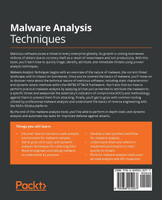
Malware Analysis Techniques
Tricks for the triage of adversarial software
Delivery estimate
Please enter a valid 4-digit Australian postcode.
to ·
Delivery estimate
Please enter a valid 4-digit Australian postcode.
to ·

Malware Analysis Techniques
Description
Analyze malicious samples, write reports, and use industry-standard methodologies to confidently triage and analyze adversarial software and malware
Key Features:
- Investigate, detect, and respond to various types of malware threat
- Understand how to use what you've learned as an analyst to produce actionable IOCs and reporting
- Explore complete solutions, detailed walkthroughs, and case studies of real-world malware samples
Book Description:
Malicious software poses a threat to every enterprise globally. Its growth is costing businesses millions of dollars due to currency theft as a result of ransomware and lost productivity. With this book, you'll learn how to quickly triage, identify, attribute, and remediate threats using proven analysis techniques.
Malware Analysis Techniques begins with an overview of the nature of malware, the current threat landscape, and its impact on businesses. Once you've covered the basics of malware, you'll move on to discover more about the technical nature of malicious software, including static characteristics and dynamic attack methods within the MITRE ATT&CK framework. You'll also find out how to perform practical malware analysis by applying all that you've learned to attribute the malware to a specific threat and weaponize the adversary's indicators of compromise (IOCs) and methodology against them to prevent them from attacking. Finally, you'll get to grips with common tooling utilized by professional malware analysts and understand the basics of reverse engineering with the NSA's Ghidra platform.
By the end of this malware analysis book, you'll be able to perform in-depth static and dynamic analysis and automate key tasks for improved defense against attacks.
What You Will Learn:
- Discover how to maintain a safe analysis environment for malware samples
- Get to grips with static and dynamic analysis techniques for collecting IOCs
- Reverse-engineer and debug malware to understand its purpose
- Develop a well-polished workflow for malware analysis
- Understand when and where to implement automation to react quickly to threats
- Perform malware analysis tasks such as code analysis and API inspection
Who this book is for:
This book is for incident response professionals, malware analysts, and researchers who want to sharpen their skillset or are looking for a reference for common static and dynamic analysis techniques. Beginners will also find this book useful to get started with learning about malware analysis. Basic knowledge of command-line interfaces, familiarity with Windows and Unix-like filesystems and registries, and experience in scripting languages such as PowerShell, Python, or Ruby will assist with understanding the concepts covered.
Shipping & Processing
This item is in stock with our supplier and usually ships within 3–5 business days.
Processing times
- In stock: Items marked “In Stock” are on our shelves. We pick, pack and ship them within 1–2 business days.
- In stock with our supplier: Items not marked “In Stock” are held by one of our Australian or overseas suppliers. We order them in for you and they usually dispatch within 2–5 business days (3–5 for some suppliers). The estimate next to the price is for this item.
- Special orders: Some supplier items, such as specialist and imported items, titles awaiting reprint and print-on-demand titles, take longer to arrive. If your order includes one, we’ll update you as soon as we hear from our supplier.
- Supplier delays: Occasionally a supplier is delayed, or their stock information turns out to be inaccurate. We’ll keep your order open for up to 60 days. If an item hasn’t shipped or isn’t on its way to us by then, we’ll cancel that item and refund it.
How accurate is availability?
Availability is based on the stock levels our suppliers tell us they hold, and we update it regularly. If a supplier issue affects your order, we’ll let you know with an updated estimate.
Delivery
- As soon as your order ships you’ll get an email with tracking.
- Australia Post usually delivers within 2–10 business days of shipping (around 4 in metro areas and around 6 in regional areas).
- If your order has more than one item, we hold the in-stock items until everything is ready, so we can ship your whole order together in one parcel.
- Shipping cost: Free on orders over $100 within Australia, otherwise $9.95 flat rate per order however many items you buy. Free shipping applies to Australian addresses only; delivery to New Zealand is $14.95 per order.
- Check your address: If an order goes to an incorrect address you gave us, or isn’t collected and Australia Post returns it to us, you’ll need to pay the postage to send it again.
Cancellations
Need to change or cancel an order? Contact us as soon as possible at contact@bookloop.com.au or through our contact page.
- Within 30 minutes: You can change or cancel your order for a full refund within 30 minutes of placing it.
- After 30 minutes: Your order is already being processed, so it can no longer be changed or cancelled. If we can accept a late cancellation, we may offer store credit instead of a refund.
- Items in transit: Once an item is on its way, either from our supplier to us or from us to you, it can’t be cancelled. If you no longer want it once it arrives, you can return it as a change of mind, with return postage at your cost. See Returns.
- Separate orders can’t be combined once they’ve been placed, and adding or swapping items can change the delivery estimate.
- Supplier delays: Occasionally a supplier is delayed, or their stock information turns out to be inaccurate. We’ll keep your order open for up to 60 days. If an item hasn’t shipped or isn’t on its way to us by then, we’ll cancel that item and refund it.
Faulty or damaged items are always covered. See Returns.
Returns
Damaged or incorrect items (within 30 days)
If an item arrives damaged or isn’t what you ordered, contact us within 30 days of delivery. We may ask for a photo, and if we need the item back we’ll send a prepaid return label, so it costs you nothing. You’ll receive a replacement or refund, as guaranteed under the Australian Consumer Law.
Change of mind (within 30 days)
We offer a refund or store credit for change of mind within 30 days of purchase when:
- you have your proof of purchase;
- the item is unused and in its original condition and packaging;
- it isn’t a sale item, special order, custom item or gift voucher.
You pay the postage to return change-of-mind items. Change-of-mind returns aren’t available for print-on-demand titles or bulk orders with special pricing.
Returned to sender
If an order is sent to an incorrect address you gave us, or isn’t collected and Australia Post returns it to us, you’ll need to pay the postage to send it again.