
Trending Bestseller

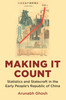
Making It Count

No reviews yet Write a Review
Paperback / softback
1 March 2022
360 Pages
RRP: $59.99
$58.00
Ships in 5-7 business days
Hurry up! Current stock:


In 1949, at the end of a long period of wars, one of the biggest challenges facing leaders of the new People’s Republic of China was how much they did not know. The government of one of the world’s largest nations was committed to fundamentally reengineering its society and economy via socialist planning while having almost no reliable statistical data about their own country. Making It Count is the history of efforts to resolve this “crisis in counting.” Drawing on a wealth of sources culled from China, India, and the United States, Arunabh Ghosh explores the choices made by political leaders, statisticians, academics, statistical workers, and even literary figures in attempts to know the nation through numbers.

Ghosh shows that early reliance on Soviet-inspired methods of exhaustive enumeration became increasingly untenable in China by the mid-1950s. Unprecedented and unexpected exchanges with Indian statisticians followed, as the Chinese sought to learn about the then-exciting new technology of random sampling. These developments were overtaken by the tumult of the Great Leap Forward (1958–61), when probabilistic and exhaustive methods were rejected and statistics was refashioned into an ethnographic enterprise. By acknowledging Soviet and Indian influences, Ghosh not only revises existing models of Cold War science but also globalizes wider developments in the history of statistics and data.

Anchored in debates about statistics and its relationship to state building, Making It Count offers fresh perspectives on China’s transition to socialism.

'Arunabh Ghosh could not have imagined how timely his book would be when he set out more than a decade ago on his research project. But Making It Count, an academic work published by Princeton University Press examining the history of statistics in China, lands at a time when the world is wondering: How does Beijing collect data, and what did it know about COVID-19 and when?' – Melissa Chan, Foreign Policy

'[Ghosh] deftly explores deeper questions about how state-making unfolded during the early years of the PRC, how ideology came to permeate every facet of the governing apparatus, and how strategies of enumeration are invariably bound, in complex ways, to the expression of political power. As such, Making It Count is an essential addition to any reading list on PRC history, as well to research methods in the social sciences and the humanities.'– Patricia M. Thornton, China Quarterly

'A remarkably well-researched and well-written book.' – Kristin Shi-Kupfer, MERICS China Briefing

You Can Find This Book In

    Book Details
    ISBN-13
    9780691199719
    Author
    Arunabh Ghosh
    Publisher
    Princeton University Press
    Published
    1 March 2022
    Format
    Paperback / softback
    Pages
    360

    This product hasn't received any reviews yet. Be the first to review this product!

    RRP: $59.99
    $58.00
    Ships in 5-7 business days
    Hurry up! Current stock:

    Making It Count

    RRP: $59.99
    $58.00

    Description


    In 1949, at the end of a long period of wars, one of the biggest challenges facing leaders of the new People’s Republic of China was how much they did not know. The government of one of the world’s largest nations was committed to fundamentally reengineering its society and economy via socialist planning while having almost no reliable statistical data about their own country. Making It Count is the history of efforts to resolve this “crisis in counting.” Drawing on a wealth of sources culled from China, India, and the United States, Arunabh Ghosh explores the choices made by political leaders, statisticians, academics, statistical workers, and even literary figures in attempts to know the nation through numbers.

    Ghosh shows that early reliance on Soviet-inspired methods of exhaustive enumeration became increasingly untenable in China by the mid-1950s. Unprecedented and unexpected exchanges with Indian statisticians followed, as the Chinese sought to learn about the then-exciting new technology of random sampling. These developments were overtaken by the tumult of the Great Leap Forward (1958–61), when probabilistic and exhaustive methods were rejected and statistics was refashioned into an ethnographic enterprise. By acknowledging Soviet and Indian influences, Ghosh not only revises existing models of Cold War science but also globalizes wider developments in the history of statistics and data.

    Anchored in debates about statistics and its relationship to state building, Making It Count offers fresh perspectives on China’s transition to socialism.

    'Arunabh Ghosh could not have imagined how timely his book would be when he set out more than a decade ago on his research project. But Making It Count, an academic work published by Princeton University Press examining the history of statistics in China, lands at a time when the world is wondering: How does Beijing collect data, and what did it know about COVID-19 and when?' – Melissa Chan, Foreign Policy

    '[Ghosh] deftly explores deeper questions about how state-making unfolded during the early years of the PRC, how ideology came to permeate every facet of the governing apparatus, and how strategies of enumeration are invariably bound, in complex ways, to the expression of political power. As such, Making It Count is an essential addition to any reading list on PRC history, as well to research methods in the social sciences and the humanities.'– Patricia M. Thornton, China Quarterly

    'A remarkably well-researched and well-written book.' – Kristin Shi-Kupfer, MERICS China Briefing

    You Can Find This Book In

      Book Details

      ISBN-13
      9780691199719
      Author
      Arunabh Ghosh
      Publisher
      Princeton University Press
      Published
      1 March 2022
      Format
      Paperback / softback
      Pages
      360

      This Book Is Categorised As