
Trending Bestseller

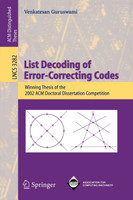
List Decoding of Error-Correcting Codes

Winning Thesis of the 2002 ACM Doctoral Dissertation Competition

No reviews yet Write a Review
Paperback / softback
29 November 2004
$121.54
Ships in 3-5 business days
Hurry up! Current stock:
How can one exchange information e?ectively when the medium of com- nication introduces errors? This question has been investigated extensively starting with the seminal works of Shannon (1948) and Hamming (1950), and has led to the rich theory of "error-correcting codes". This theory has traditionally gone hand in hand with the algorithmic theory of "decoding" that tackles the problem of recovering from the errors e?ciently. This thesis presents some spectacular new results in the area of decoding algorithms for error-correctingcodes. Speci?cally,itshowshowthenotionof"list-decoding" can be applied to recover from far more errors, for a wide variety of err- correcting codes, than achievable before. A brief bit of background: error-correcting codes are combinatorial str- tures that show how to represent (or "encode") information so that it is - silient to a moderate number of errors. Speci?cally, an error-correcting code takes a short binary string, called the message, and shows how to transform it into a longer binary string, called the codeword, so that if a small number of bits of the codewordare ?ipped, the resulting string does not look like any other codeword. The maximum number of errorsthat the code is guaranteed to detect, denoted d, is a central parameter in its design. A basic property of such a code is that if the number of errors that occur is known to be smaller than d/2, the message is determined uniquely. This poses a computational problem,calledthedecodingproblem:computethemessagefromacorrupted codeword, when the number of errors is less than d/2.

You Can Find This Book In

    Book Details
    ISBN-13
    9783540240518
    Author
    Venkatesan Guruswami
    Publisher
    Springer Nature B.V.
    Published
    29 November 2004
    Format
    Paperback / softback

    This product hasn't received any reviews yet. Be the first to review this product!

    $121.54
    Ships in 3-5 business days
    Hurry up! Current stock:

    List Decoding of Error-Correcting Codes

    $121.54

    Description

    How can one exchange information e?ectively when the medium of com- nication introduces errors? This question has been investigated extensively starting with the seminal works of Shannon (1948) and Hamming (1950), and has led to the rich theory of "error-correcting codes". This theory has traditionally gone hand in hand with the algorithmic theory of "decoding" that tackles the problem of recovering from the errors e?ciently. This thesis presents some spectacular new results in the area of decoding algorithms for error-correctingcodes. Speci?cally,itshowshowthenotionof"list-decoding" can be applied to recover from far more errors, for a wide variety of err- correcting codes, than achievable before. A brief bit of background: error-correcting codes are combinatorial str- tures that show how to represent (or "encode") information so that it is - silient to a moderate number of errors. Speci?cally, an error-correcting code takes a short binary string, called the message, and shows how to transform it into a longer binary string, called the codeword, so that if a small number of bits of the codewordare ?ipped, the resulting string does not look like any other codeword. The maximum number of errorsthat the code is guaranteed to detect, denoted d, is a central parameter in its design. A basic property of such a code is that if the number of errors that occur is known to be smaller than d/2, the message is determined uniquely. This poses a computational problem,calledthedecodingproblem:computethemessagefromacorrupted codeword, when the number of errors is less than d/2.

    You Can Find This Book In

      Book Details

      ISBN-13
      9783540240518
      Author
      Venkatesan Guruswami
      Publisher
      Springer Nature B.V.
      Published
      29 November 2004
      Format
      Paperback / softback

      This Book Is Categorised As