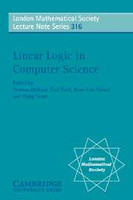
Linear logic is a branch of proof theory which provides refined tools for the study of the computational aspects of proofs. These tools include a duality-based categorical semantics, an intrinsic graphical representation of proofs, the introduction of well-behaved non-commutative logical connectives, and the concepts of polarity and focalisation. These various aspects are illustrated here through introductory tutorials as well as more specialised contributions, with a particular emphasis on applications to computer science: denotational semantics, lambda-calculus, logic programming and concurrency theory. The volume is rounded-off by two invited contributions on new topics rooted in recent developments of linear logic. The book derives from a summer school that was the climax of the EU Training and Mobility of Researchers project 'Linear Logic in Computer Science'. It is an excellent introduction to some of the most active research topics in the area.
In this monograph we introduce and examine four new temporal logic formalisms that can be used as specification languages for the automated verification of the reliability of hardware and software...
The Symposium on Logical Foundations of Computer Science series provides a forum for the fast-growing body of work in the logical foundations of computer science, e.g., those areas of fundamental...