
Trending Bestseller

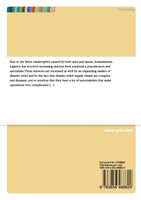
Last Mile Distribution in Disaster Relief Chains

Challenges and Opportunities for the Humanitarian Sector

No reviews yet Write a Review
Paperback / softback
05 August 2013
RRP: $96.69
$94.76
Ships in 3-5 business days
Hurry up! Current stock:
Bachelor Thesis from the year 2012 in the subject Business economics - Supply, Production, Logistics, grade: 2,3, University of Cologne (Department of Supply Chain Management and Management Science), course: Supply Chain Management, language: English, abstract: Due to the latest catastrophes caused by both man and nature, humanitarian logistics has received increasing interest from academics, practitioners and specialists. These interests are increased as well by an expanding market of disaster relief and by the fact that disaster relief supply chains are complex and dynamic, not to mention that they have a lot of uncertainties that make operations very complicated. Especially in disaster relief, the supply chains have to be fast, agile and flexible in order to rapidly provide the appropriate amount, and type of emergency supplies, to minimize human suffering or death.The last mile distribution is the final stage of the disaster relief supply chain, i.e. the delivery of relief supplies from local distribution centres to beneficiaries affected by disasters. The main problems for the last mile are:• Supplies have to be carried out rapidly in an environment with destabilized infrastructures• Limitations related to transportation resources and emergency supplies• Lack of coordination among relief actors• Insufficient information about demand and need for help To solve these problems, the private sector approaches of the last mile can be conducted and innovative technologies can be implemented. The aim of this paper is to give an overview of supply chains in disaster relief, identify the main problems of the last mile distribution in disaster relief operations, describe optimization possibilities of the private sector, and examine the applicability for disaster situations.

You Can Find This Book In

    Book Details
    ISBN-13
    9783656468820
    Author
    Michael Decker
    Publisher
    GRIN Verlag
    Published
    05 August 2013
    Format
    Paperback / softback

    This product hasn't received any reviews yet. Be the first to review this product!

    RRP: $96.69
    $94.76
    Ships in 3-5 business days
    Hurry up! Current stock:

    Last Mile Distribution in Disaster Relief Chains

    RRP: $96.69
    $94.76

    Description

    Bachelor Thesis from the year 2012 in the subject Business economics - Supply, Production, Logistics, grade: 2,3, University of Cologne (Department of Supply Chain Management and Management Science), course: Supply Chain Management, language: English, abstract: Due to the latest catastrophes caused by both man and nature, humanitarian logistics has received increasing interest from academics, practitioners and specialists. These interests are increased as well by an expanding market of disaster relief and by the fact that disaster relief supply chains are complex and dynamic, not to mention that they have a lot of uncertainties that make operations very complicated. Especially in disaster relief, the supply chains have to be fast, agile and flexible in order to rapidly provide the appropriate amount, and type of emergency supplies, to minimize human suffering or death.The last mile distribution is the final stage of the disaster relief supply chain, i.e. the delivery of relief supplies from local distribution centres to beneficiaries affected by disasters. The main problems for the last mile are:• Supplies have to be carried out rapidly in an environment with destabilized infrastructures• Limitations related to transportation resources and emergency supplies• Lack of coordination among relief actors• Insufficient information about demand and need for help To solve these problems, the private sector approaches of the last mile can be conducted and innovative technologies can be implemented. The aim of this paper is to give an overview of supply chains in disaster relief, identify the main problems of the last mile distribution in disaster relief operations, describe optimization possibilities of the private sector, and examine the applicability for disaster situations.

    You Can Find This Book In

      This Book Is Categorised As