
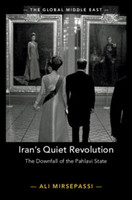
Offering a new perspective on Iran's politics and culture in the 1960s and 1970s, Ali Mirsepassi challenges the prevailing view of pre-Revolution Iran, documenting how the cultural elites of the Pahlavi State promoted a series of striking 'Gharbzadegi' or 'Westoxification' discourses. Intended as ideological alternatives to modern and Western-inspired cultural attitudes, these influenced Persian identity politics, and projected Iranian modernity as a 'mistaken modernity' despite the regime's own ferocious modernisation programme. Focusing on the cultural transformations which defined the period, Mirsepassi sheds new light on the Pahlavi State as an ideological gambler, inadvertently empowering its fundamentalist enemies and spreading a 'quiet revolution' through secular and religious civil society. Proposing a new theoretical framework for understanding the anti-modern discourses of Ahmad Fardid, Jalal Al-e Ahmad, and Ali Shari'ati, Iran's Quiet Revolution is a radical re-interpretation of twentieth century Iranian political history which makes sense of these events within the creative, yet tragic Iranian nation-making experience.
Observers of Iran have often ascribed the main cause of the revolution to economic problems under the Shah's regime. This book, first published in 1990, on the other hand focuses on the political and...
Intolerance of different religions, miscommunication, and bigotry. It doesn't have to be this way. A global revolution is emerging - interfaith. In an increasingly politically and religiously...