


Inventing Comics
A New Translation of Rodolphe Töpffer's Reflections on Graphic Storytelling, Media Rhetorics, and Aesthetic Practice
Delivery estimate
Please enter a valid 4-digit Australian postcode.
to ·
Delivery estimate
Please enter a valid 4-digit Australian postcode.
to ·

Inventing Comics
Description
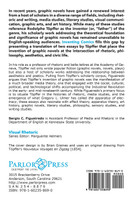
In recent years, graphic novels have gained a renewed interest from a host of scholars in a diverse range of fields, including rhetoric and writing, media studies, literary studies, visual communication, graphic arts, and art history. While many of these studies reference Rodolphe Töpffer as the inventor (or, “father”) of the genre, his scholarly work addressing the theoretical foundation and significance of graphic novels has remained unavailable to English-speaking audiences. Inventing Comics fills this gap by presenting a translation of two essays by Töpffer that place the invention of graphic novels at the intersection of rhetoric, philosophy, aesthetics, and civic life.
In his role as a professor of rhetoric and belle-lettres at the Academy of Geneva, Töpffer not only wrote popular fiction (graphic novels, novels, plays) but also a host of scholarly works addressing the relationship between aesthetics and poetics. Pulling from Töpffer’s scholarly corpus, Figueiredo argues that Töpffer’s invention of graphic novels was the manifestation of a much broader media theory, one that engaged with the social, cultural, political, and technological shifts accompanying the Industrial Revolution in the early- and mid-nineteenth century. While Figueiredo’s primary focus is to situate Töpffer in the histories of rhetoric, media studies, and the emergence of what Gregory L. Ulmer has called the apparatus of electracy, these essays also resonate with affect theory, apparatus theory, art history, graphic novels, literary studies, philosophy, sensory studies, and writing studies.
About the Editor and Translator
Sergio C. Figueiredo is Assistant Professor of Media and Rhetoric in the Department of English at Kennesaw State University. He received his PhD in Rhetorics, Communication, and Information Design from Clemson University, and his MA in English from Marshall University. His research focuses on the intersections of rhetorical theory, media studies, and electracy. His work has appeared in Textshop Experiments, ImageTexT: Interdisciplinary Comics Studies, Journal of Visual Literacy, and In Media Res: A Media Commons Project. He serves as a Fellow with the Global Art and Ideas Nexus, contributing to the organization’s e-Magazine, Esthesis, and special programs, including the Critical Conversations series.
Shipping & Processing
This item is in stock with our supplier and usually ships within 3–5 business days.
Processing times
- In stock: Items marked “In Stock” are on our shelves. We pick, pack and ship them within 1–2 business days.
- In stock with our supplier: Items not marked “In Stock” are held by one of our Australian or overseas suppliers. We order them in for you and they usually dispatch within 2–5 business days (3–5 for some suppliers). The estimate next to the price is for this item.
- Special orders: Some supplier items, such as specialist and imported items, titles awaiting reprint and print-on-demand titles, take longer to arrive. If your order includes one, we’ll update you as soon as we hear from our supplier.
- Supplier delays: Occasionally a supplier is delayed, or their stock information turns out to be inaccurate. We’ll keep your order open for up to 60 days. If an item hasn’t shipped or isn’t on its way to us by then, we’ll cancel that item and refund it.
How accurate is availability?
Availability is based on the stock levels our suppliers tell us they hold, and we update it regularly. If a supplier issue affects your order, we’ll let you know with an updated estimate.
Delivery
- As soon as your order ships you’ll get an email with tracking.
- Australia Post usually delivers within 2–10 business days of shipping (around 4 in metro areas and around 6 in regional areas).
- If your order has more than one item, we hold the in-stock items until everything is ready, so we can ship your whole order together in one parcel.
- Shipping cost: Free on orders over $100 within Australia, otherwise $9.95 flat rate per order however many items you buy. Free shipping applies to Australian addresses only; delivery to New Zealand is $14.95 per order.
- Check your address: If an order goes to an incorrect address you gave us, or isn’t collected and Australia Post returns it to us, you’ll need to pay the postage to send it again.
Cancellations
Need to change or cancel an order? Contact us as soon as possible at contact@bookloop.com.au or through our contact page.
- Within 30 minutes: You can change or cancel your order for a full refund within 30 minutes of placing it.
- After 30 minutes: Your order is already being processed, so it can no longer be changed or cancelled. If we can accept a late cancellation, we may offer store credit instead of a refund.
- Items in transit: Once an item is on its way, either from our supplier to us or from us to you, it can’t be cancelled. If you no longer want it once it arrives, you can return it as a change of mind, with return postage at your cost. See Returns.
- Separate orders can’t be combined once they’ve been placed, and adding or swapping items can change the delivery estimate.
- Supplier delays: Occasionally a supplier is delayed, or their stock information turns out to be inaccurate. We’ll keep your order open for up to 60 days. If an item hasn’t shipped or isn’t on its way to us by then, we’ll cancel that item and refund it.
Faulty or damaged items are always covered. See Returns.
Returns
Damaged or incorrect items (within 30 days)
If an item arrives damaged or isn’t what you ordered, contact us within 30 days of delivery. We may ask for a photo, and if we need the item back we’ll send a prepaid return label, so it costs you nothing. You’ll receive a replacement or refund, as guaranteed under the Australian Consumer Law.
Change of mind (within 30 days)
We offer a refund or store credit for change of mind within 30 days of purchase when:
- you have your proof of purchase;
- the item is unused and in its original condition and packaging;
- it isn’t a sale item, special order, custom item or gift voucher.
You pay the postage to return change-of-mind items. Change-of-mind returns aren’t available for print-on-demand titles or bulk orders with special pricing.
Returned to sender
If an order is sent to an incorrect address you gave us, or isn’t collected and Australia Post returns it to us, you’ll need to pay the postage to send it again.