Residual stresses are always introduced in materials when they are produced, or when they undergo non-uniform plastic deformation during use. The circumstances that can cause residual stresses are therefore numerous. Residual stresses exist in all materials and, depending on their distribution, can playa beneficial role (for example, compressive surface stress) or have a catastrophic effect, especially on fatigue behaviour and corrosion properties. The subject of residual stresses took form around 1970 with the development of methods to measure macroscopic deformations during the machining of materials or on an atomic scale by X-ray diffraction. These techniques have made considerable progress in the last 20 years. The meetings organized in several countries (Germany, France, Japan, etc. ) have largely contributed to this progress, aided by the numerous exchanges of information and knowledge to which they have given rise. Studies of the formation of residual stresses began more slowly, but have progressed with the emergence of increasingly realistic models of materials behaviour and with access to ever more powerful codes for numerical calculations. Two successive meetings for discussing this topic have been held in Europe. The first, held in 1982 in Nancy (France), consisted of 30 participants from 5 countries. The second was held in Linkoping (Sweden) in 1984, with 80 participants of 16 nationalities. It was decided to hold a first International Conference, ICRS, to address all aspects of the problem. Held in 1986 in Garmisch-Partenkirschen (FRG), it was an assembly of neady 300 participants from 21 countries.
Residual stresses are always introduced in materials when they are produced, or when they undergo non-uniform plastic deformation during use. The circumstances that can cause residual stresses are therefore numerous. Residual stresses exist in all materials and, depending on their distribution, can playa beneficial role (for example, compressive surface stress) or have a catastrophic effect, especially on fatigue behaviour and corrosion properties. The subject of residual stresses took form around 1970 with the development of methods to measure macroscopic deformations during the machining of materials or on an atomic scale by X-ray diffraction. These techniques have made considerable progress in the last 20 years. The meetings organized in several countries (Germany, France, Japan, etc. ) have largely contributed to this progress, aided by the numerous exchanges of information and knowledge to which they have given rise. Studies of the formation of residual stresses began more slowly, but have progressed with the emergence of increasingly realistic models of materials behaviour and with access to ever more powerful codes for numerical calculations. Two successive meetings for discussing this topic have been held in Europe. The first, held in 1982 in Nancy (France), consisted of 30 participants from 5 countries. The second was held in Linkoping (Sweden) in 1984, with 80 participants of 16 nationalities. It was decided to hold a first International Conference, ICRS, to address all aspects of the problem. Held in 1986 in Garmisch-Partenkirschen (FRG), it was an assembly of neady 300 participants from 21 countries.
The Army Materials and Mechanics Research Center in coop eration with the Materials Science Group of the Department of Chemical Engineering and Materials Science of Syracuse University has been...
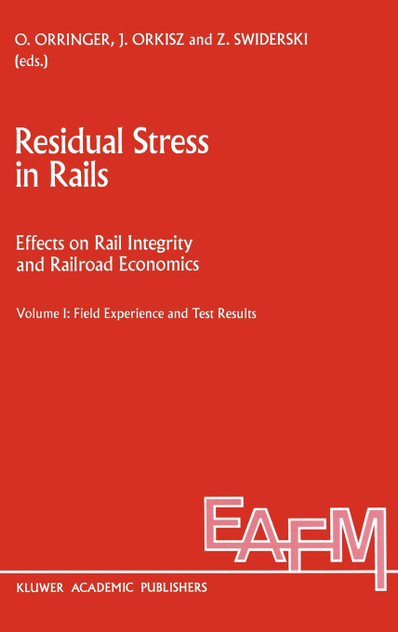
Rail integrity is a current application of engineering fracture mechanics at a practical level. Although railroad rails have been manufactured and used for more than a century, it is only in the last...
This book presents the proceedings of the International Conference on Residual Stresses 10 and is devoted to the prediction/modelling, evaluation, control, and application of residual stresses in...
Discover your next great read at BookLoop, Australiand online bookstore offering a vast selection of titles across various genres and interests. Whether you're curious about what's trending or searching for graphic novels that captivate, thrilling crime and mystery fiction, or exhilarating action and adventure stories, our curated collections have something for every reader. Delve into imaginative fantasy worlds or explore the realms of science fiction that challenge the boundaries of reality. Fans of contemporary narratives will find compelling stories in our contemporary fiction section. Embark on epic journeys with our fantasy and science fiction titles,
Shop Trending Books and New Releases
Explore our new releases for the most recent additions in romance books, fantasy books, graphic novels, crime and mystery books, science fiction books as well as biographies, cookbooks, self help books, tarot cards, fortunetelling and much more. With titles covering current trends, booktok and bookstagram recommendations, and emerging authors, BookLoop remains your go-to local australian bookstore for buying books online across all book genres.
Shop Best Books By Collection
Stay updated with the literary world by browsing our trending books, featuring the latest bestsellers and critically acclaimed works. Explore titles from popular brands like Minecraft, Pokemon, Star Wars, Bluey, Lonely Planet, ABIA award winners, Peppa Pig, and our specialised collection of ADHD books. At BookLoop, we are committed to providing a diverse and enriching reading experience for all.
Sign In
your cart
Your cart is empty
Menu
Search
PRE-SALES
If you have any questions before making a purchase chat with our online operators to get more information.