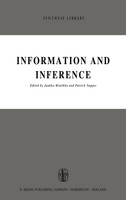
In the last 25 years, the concept of information has played a crucial role in communication theory, so much so that the terms information theory and communication theory are sometimes used almost interchangeably. It seems to us, however, that the notion of information is also destined to render valuable services to the student of induction and probability, of learning and reinforcement, of semantic meaning and deductive inference, as~well as of scientific method in general. The present volume is an attempt to illustrate some of these uses of information concepts. In 'On Semantic Information' Hintikka summarizes some of his and his associates' recent work on information and induction, and comments briefly on its philosophical suggestions. Jamison surveys from the sub jectivistic point of view some recent results in 'Bayesian Information Usage'. Rosenkrantz analyzes the information obtained by experimen tation from the Bayesian and Neyman-Pearson standpoints, and also from the standpoint of entropy and related concepts. The much-debated principle of total evidence prompts Hilpinen to examine the problem of measuring the information yield of observations in his paper 'On the Information Provided by Observations'. Pietarinen addresses himself to the more general task of evaluating the systematizing ('explanatory') power of hypotheses and theories, a task which quickly leads him to information concepts. Domotor develops a qualitative theory of information and entropy. His paper gives what is probably the first axiomatization of a general qualitative theory of information adequate to guarantee a numerical representation of the standard sort.
In the last 25 years, the concept of information has played a crucial role in communication theory, so much so that the terms information theory and communication theory are sometimes used almost interchangeably. It seems to us, however, that the notion of information is also destined to render valuable services to the student of induction and probability, of learning and reinforcement, of semantic meaning and deductive inference, as~well as of scientific method in general. The present volume is an attempt to illustrate some of these uses of information concepts. In 'On Semantic Information' Hintikka summarizes some of his and his associates' recent work on information and induction, and comments briefly on its philosophical suggestions. Jamison surveys from the sub jectivistic point of view some recent results in 'Bayesian Information Usage'. Rosenkrantz analyzes the information obtained by experimen tation from the Bayesian and Neyman-Pearson standpoints, and also from the standpoint of entropy and related concepts. The much-debated principle of total evidence prompts Hilpinen to examine the problem of measuring the information yield of observations in his paper 'On the Information Provided by Observations'. Pietarinen addresses himself to the more general task of evaluating the systematizing ('explanatory') power of hypotheses and theories, a task which quickly leads him to information concepts. Domotor develops a qualitative theory of information and entropy. His paper gives what is probably the first axiomatization of a general qualitative theory of information adequate to guarantee a numerical representation of the standard sort.
Under the title 'Information, Inference and Decision' this volume in the Theory and Decision Library presents some papers on issues from the borderland of statistical inference philosophy and...
Conditionals are fascinating and versatile objects of knowledge representation. On the one hand, they may express rules in a very general sense, representing, for example, plausible relationships,...
Klemens Szaniawski was born in Warsaw on March 3, 1925. He began to study philosophy in the clandestine Warsaw University during World War II. Tadeusz Kotarbinski, Jan Lukasiewicz, Maria and...
Discover your next great read at BookLoop, Australiand online bookstore offering a vast selection of titles across various genres and interests. Whether you're curious about what's trending or searching for graphic novels that captivate, thrilling crime and mystery fiction, or exhilarating action and adventure stories, our curated collections have something for every reader. Delve into imaginative fantasy worlds or explore the realms of science fiction that challenge the boundaries of reality. Fans of contemporary narratives will find compelling stories in our contemporary fiction section. Embark on epic journeys with our fantasy and science fiction titles,
Shop Trending Books and New Releases
Explore our new releases for the most recent additions in romance books, fantasy books, graphic novels, crime and mystery books, science fiction books as well as biographies, cookbooks, self help books, tarot cards, fortunetelling and much more. With titles covering current trends, booktok and bookstagram recommendations, and emerging authors, BookLoop remains your go-to local australian bookstore for buying books online across all book genres.
Shop Best Books By Collection
Stay updated with the literary world by browsing our trending books, featuring the latest bestsellers and critically acclaimed works. Explore titles from popular brands like Minecraft, Pokemon, Star Wars, Bluey, Lonely Planet, ABIA award winners, Peppa Pig, and our specialised collection of ADHD books. At BookLoop, we are committed to providing a diverse and enriching reading experience for all.
Sign In
your cart
Your cart is empty
Menu
Search
PRE-SALES
If you have any questions before making a purchase chat with our online operators to get more information.