
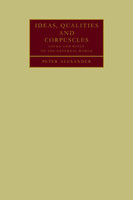
This study presents a substantial and often radical reinterpretation of some of the central themes of Locke's thought. Professor Alexander concentrates on the Essay Concerning Human Understanding and aims to restore that to its proper historical context. In Part I he gives a clear exposition of some of the scientific theories of Robert Boyle, which, he argues, heavily influenced Locke in employing similar concepts and terminology. Against this background, he goes on in Part II to provide an account of Locke's views on the external world and our knowledge of it. He shows those views to be more consistent and plausible than is generally allowed, demonstrating how they make sense and enable scientific explanations of nature. In examining the views of Locke and Boyle together, the book throws light both on the development of philosophy and the beginnings of modern science, and in particular it makes a considerable and original contribution to our understanding of Locke's philosophy.
This work has been selected by scholars as being culturally important and is part of the knowledge base of civilization as we know it.This work is in the public domain in the United States of...
In Elements, Principles and Particles, Antonio Clericuzio explores the relationships between chemistry and corpuscular philosophy in the age of the Scientific Revolution. Science historians ...
The Life and Times of Cornelius Corpuscle takes you on a journey through the bustling arteries of the human body, home to a staggering 20 to 30 trillion red blood cells. Among these crimson...