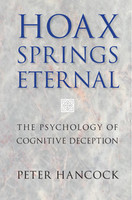
Unlike sleights of hand, which fool the senses, sleights of mind challenge cognition. This book defines and explains cognitive deception and explores six prominent potential historical instances of it: the Cross of King Arthur, Drake's Plate of Brass, the Kensington Runestone, the Vinland Map, the Piltdown Man, and the Shroud of Turin. In spite of evidence contradicting their alleged origins, their stories continue to persuade many of their authenticity. Peter Hancock uses these purported hoaxes as case studies to develop and demonstrate fundamental principles of cognitive psychology. By dissecting each ostensible artifact, he illustrates how hoaxes can deceive us and offers us defenses against them. This book further examines how and why we allow others to deceive us and how and why we even deceive ourselves at times. Accessible to beginner and expert alike, Hoax Springs Eternal provides an essential interdisciplinary guide to cognitive deception.
A young man with an extraordinary gift. A zealous commune isolated from the world. What could possibly go wrong? At fifteen, Joshua Moses has always lived inside the isolated commune known as the...
This work has been selected by scholars as being culturally important, and is part of the knowledge base of civilization as we know it.This work is in the "public domain in the United States of...
Esther Recinos has a passion for people and a love for her adopted country of Guatemala, "The Land of Eternal Spring." Although Esther was born in the United States, when she was a little girl her...
Four musicians had a dream. Their success will help you find yours. Gus, Lin, Herman and Rash are four talented musicians playing Irish and Scottish music with a punk twist. They're nonconformists...