
Trending Bestseller

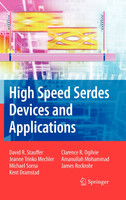
High Speed Serdes Devices and Applications

No reviews yet Write a Review
Hardback
01 December 2008
RRP: $328.90
$323.97
Ships in 3-5 business days
Hurry up! Current stock:
The simplest method of transferring data through the inputs or outputs of a silicon chip is to directly connect each bit of the datapath from one chip to the next chip. Once upon a time this was an acceptable approach. However, one aspect (and perhaps the only aspect) of chip design which has not changed during the career of the authors is Moore's Law, which has dictated substantial increases in the number of circuits that can be manufactured on a chip. The pin densities of chip packaging technologies have not increased at the same pace as has silicon density, and this has led to a prevalence of High Speed Serdes (HSS) devices as an inherent part of almost any chip design. HSS devices are the dominant form of input/output for many (if not most) high-integration chips, moving serial data between chips at speeds up to 10 Gbps and beyond. Chip designers with a background in digital logic design tend to view HSS devices as simply complex digital input/output cells. This view ignores the complexity associated with serially moving billions of bits of data per second. At these data rates, the assumptions associated with digital signals break down and analog factors demand consideration. The chip designer who oversimplifies the problem does so at his or her own peril.

You Can Find This Book In

    Book Details
    ISBN-13
    9780387798332
    Author
    David Robert Stauffer
    Publisher
    Springer Nature B.V.
    Published
    01 December 2008
    Format
    Hardback

    This product hasn't received any reviews yet. Be the first to review this product!

    RRP: $328.90
    $323.97
    Ships in 3-5 business days
    Hurry up! Current stock:

    High Speed Serdes Devices and Applications

    RRP: $328.90
    $323.97

    Description

    The simplest method of transferring data through the inputs or outputs of a silicon chip is to directly connect each bit of the datapath from one chip to the next chip. Once upon a time this was an acceptable approach. However, one aspect (and perhaps the only aspect) of chip design which has not changed during the career of the authors is Moore's Law, which has dictated substantial increases in the number of circuits that can be manufactured on a chip. The pin densities of chip packaging technologies have not increased at the same pace as has silicon density, and this has led to a prevalence of High Speed Serdes (HSS) devices as an inherent part of almost any chip design. HSS devices are the dominant form of input/output for many (if not most) high-integration chips, moving serial data between chips at speeds up to 10 Gbps and beyond. Chip designers with a background in digital logic design tend to view HSS devices as simply complex digital input/output cells. This view ignores the complexity associated with serially moving billions of bits of data per second. At these data rates, the assumptions associated with digital signals break down and analog factors demand consideration. The chip designer who oversimplifies the problem does so at his or her own peril.

    You Can Find This Book In

      This Book Is Categorised As