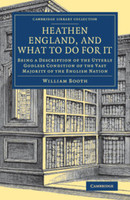
This book, published in 1877, describes both the 'utterly Godless condition of the vast majority of the English nation' and the activities of William Booth (not yet famous as the founder of the Salvation Army, first named in 1878) at the Whitechapel Christian Mission, where he had been working since 1865. It is not clear whether Booth (1829-1912) actually wrote this book: the preface is signed by 'Geo. R.', and Booth is referred to in the third person, but it is conventionally ascribed to him and certainly echoes his own beliefs. (Booth's more famous 1890 work, In Darkest England and the Way Out (also reissued in this series) was ghostwritten by journalist W.T. Stead.) Using anecdotes from Whitechapel, the book claims that the British urban working classes are in more urgent need of Christian help and education, on the model provided by Booth, than any so-called pagan society overseas.
This work has been selected by scholars as being culturally important, and is part of the knowledge base of civilization as we know it.This work is in the "public domain in the United States of...
This book provides a timely and incisive analysis of the political, economic, and social situation in England during the mid-20th century. Through a series of essays and articles, the author explores...
Why do the Heathen Rage? is a perplexity that presents a melting pot of the supernatural and the natural. Regarding this monumental collision of Donald Trump and the Left, the celestial teleprompter...
The virtuous pagans who appear in medieval English texts have often been analyzed for their theological significance, but Representing Righteous Heathens argues that such figures also functioned as...