Seminar paper from the year 2014 in the subject English Language and Literature Studies - Linguistics, grade: 1,3, University of Mannheim (Anglistische Linguistik (A1)), language: English, abstract: This paper investigates whether the syntactic features of current advertising slogans are still congruent with Leech's concept of Standard Advertising Language (established in 1966) since it is a linguistic framework still widely accepted among scholars. But more importantly, because it can provide an answer to a more far-reaching question lying behind the issue of the applicability of Leech's claims to advertising slogans today: in the course of almost half a century, has advertising language changed and does a new syntactic framework need to be established? The syntactic analysis is based on syntactic features such as sentence force, number of adjuncts, finiteness of verbs, tense and aspect, voice, type of co-ordination and number of adjectives. The findings suggest that the majority of the syntactic features of current advertising slogans are still congruent with Leech's findings. As a result, the applicability of Standard Advertising English can be extended to current advertising slogans. However, certain deviations from Leech's concept have been detected in the sample and they suggest a significant development: advertising slogans have changed in certain respects since the 1960s. In Linguistics, four different types of sentence force can be distinguished, denoted as "mood" by Leech: declarative, imperative, interrogative and exclamative. The one occurring most frequently in Leech's sample is the imperative force: in his sample, "...over one in four major independent clauses were imperative." However, only very few imperative clauses are accompanied by a negative form since advertising aims at inciting actions instead of prohibiting them. The infrequency of negative forms, thus, represents a general principle of advertising language. Likewise, interrogative clauses a
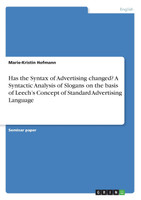
Has the Syntax of Advertising changed? A Syntactic Analysis of Slogans on the basis of Leech's Concept of Standard Advertising Language
RRP:
$72.00
Description
Seminar paper from the year 2014 in the subject English Language and Literature Studies - Linguistics, grade: 1,3, University of Mannheim (Anglistische Linguistik (A1)), language: English, abstract: This paper investigates whether the syntactic features of current advertising slogans are still congruent with Leech's concept of Standard Advertising Language (established in 1966) since it is a linguistic framework still widely accepted among scholars. But more importantly, because it can provide an answer to a more far-reaching question lying behind the issue of the applicability of Leech's claims to advertising slogans today: in the course of almost half a century, has advertising language changed and does a new syntactic framework need to be established? The syntactic analysis is based on syntactic features such as sentence force, number of adjuncts, finiteness of verbs, tense and aspect, voice, type of co-ordination and number of adjectives. The findings suggest that the majority of the syntactic features of current advertising slogans are still congruent with Leech's findings. As a result, the applicability of Standard Advertising English can be extended to current advertising slogans. However, certain deviations from Leech's concept have been detected in the sample and they suggest a significant development: advertising slogans have changed in certain respects since the 1960s. In Linguistics, four different types of sentence force can be distinguished, denoted as "mood" by Leech: declarative, imperative, interrogative and exclamative. The one occurring most frequently in Leech's sample is the imperative force: in his sample, "...over one in four major independent clauses were imperative." However, only very few imperative clauses are accompanied by a negative form since advertising aims at inciting actions instead of prohibiting them. The infrequency of negative forms, thus, represents a general principle of advertising language. Likewise, interrogative clauses a
Gender portrayals have known significant changes in print advertising over the last decades, but gender stereotypes remain widely controversial in the world of advertising nowadays. The verbal and...
Considering perspectives on creative advertising through a unique media and communications lens, this book encompasses both the theory and practical tools needed to approach and understand creativity...
Discover your next great read at BookLoop, Australiand online bookstore offering a vast selection of titles across various genres and interests. Whether you're curious about what's trending or searching for graphic novels that captivate, thrilling crime and mystery fiction, or exhilarating action and adventure stories, our curated collections have something for every reader. Delve into imaginative fantasy worlds or explore the realms of science fiction that challenge the boundaries of reality. Fans of contemporary narratives will find compelling stories in our contemporary fiction section. Embark on epic journeys with our fantasy and science fiction titles,
Shop Trending Books and New Releases
Explore our new releases for the most recent additions in romance books, fantasy books, graphic novels, crime and mystery books, science fiction books as well as biographies, cookbooks, self help books, tarot cards, fortunetelling and much more. With titles covering current trends, booktok and bookstagram recommendations, and emerging authors, BookLoop remains your go-to local australian bookstore for buying books online across all book genres.
Shop Best Books By Collection
Stay updated with the literary world by browsing our trending books, featuring the latest bestsellers and critically acclaimed works. Explore titles from popular brands like Minecraft, Pokemon, Star Wars, Bluey, Lonely Planet, ABIA award winners, Peppa Pig, and our specialised collection of ADHD books. At BookLoop, we are committed to providing a diverse and enriching reading experience for all.
Sign In
your cart
Your cart is empty
Menu
Search
PRE-SALES
If you have any questions before making a purchase chat with our online operators to get more information.