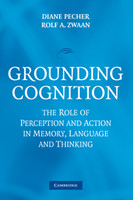
One of the key questions in cognitive psychology is how people represent knowledge about concepts such as football or love. Some researchers have proposed that concepts are represented in human memory by the sensorimotor systems that underlie interaction with the outside world. These theories represent developments in cognitive science to view cognition no longer in terms of abstract information processing, but in terms of perception and action. In other words, cognition is grounded in embodied experiences. Studies show that sensory perception and motor actions support understanding of words and object concepts. Moreover, even understanding of abstract and emotion concepts can be shown to rely on more concrete, embodied experiences. Finally, language itself can be shown to be grounded in sensorimotor processes. This book brings together theoretical arguments and empirical evidence from several key researchers in this field to support this framework.
Q: Why do organisms need cognition? A: To get information about their environments. Q: Why such information? A: Because organisms need to guide their behaviors to goals. Q: Why guidance? A: Because...
Through the systematic analysis of data from music rehearsals, lessons, and performances, this book develops a new conceptual framework for studying cognitive processes in musical activity. Grounding...
Professor Dey's persuasive, instructive, critical, engaging, and often humorous investigation places many elements of grounded theory under close scrutiny. In searching out the methodological...