The idea of the Gröbner basis first appeared in a 1927 paper by F. S. Macaulay, who succeeded in creating a combinatorial characterization of the Hilbert functions of homogeneous ideals of the polynomial ring. Later, the modern definition of the Gröbner basis was independently introduced by Heisuke Hironaka in 1964 and Bruno Buchberger in 1965. However, after the discovery of the notion of the Gröbner basis by Hironaka and Buchberger, it was not actively pursued for 20 years. A breakthrough was made in the mid-1980s by David Bayer and Michael Stillman, who created the Macaulay computer algebra system with the help of the Gröbner basis. Since then, rapid development on the Gröbner basis has been achieved by many researchers, including Bernd Sturmfels.
This book serves as a standard bible of the Gröbner basis, for which the harmony of theory, application, and computation are indispensable. It provides all the fundamentals for graduate students to learn the ABC's of the Gröbner basis, requiring no special knowledge to understand those basic points.
Starting from the introductory performance of the Gröbner basis (Chapter 1), a trip around mathematical software follows (Chapter 2). Then comes a deep discussion of how to compute the Gröbner basis (Chapter 3). These three chapters may be regarded as the first act of a mathematical play. The second act opens with topics on algebraic statistics (Chapter 4), a fascinating research area where the Gröbner basis of a toric ideal is a fundamental tool of the Markov chain Monte Carlo method. Moreover, the Gröbner basis of a toric ideal has had a great influence on the study of convex polytopes (Chapter 5). In addition, the Gröbner basis of the ring of differential operators gives effective algorithms on holonomic functions (Chapter 6). The third act (Chapter 7) is a collection of concrete examples and problems for Chapters 4, 5 and 6 emphasizing computation by using various software systems.
The idea of the Gröbner basis first appeared in a 1927 paper by F. S. Macaulay, who succeeded in creating a combinatorial characterization of the Hilbert functions of homogeneous ideals of the polynomial ring. Later, the modern definition of the Gröbner basis was independently introduced by Heisuke Hironaka in 1964 and Bruno Buchberger in 1965. However, after the discovery of the notion of the Gröbner basis by Hironaka and Buchberger, it was not actively pursued for 20 years. A breakthrough was made in the mid-1980s by David Bayer and Michael Stillman, who created the Macaulay computer algebra system with the help of the Gröbner basis. Since then, rapid development on the Gröbner basis has been achieved by many researchers, including Bernd Sturmfels.
This book serves as a standard bible of the Gröbner basis, for which the harmony of theory, application, and computation are indispensable. It provides all the fundamentals for graduate students to learn the ABC's of the Gröbner basis, requiring no special knowledge to understand those basic points.
Starting from the introductory performance of the Gröbner basis (Chapter 1), a trip around mathematical software follows (Chapter 2). Then comes a deep discussion of how to compute the Gröbner basis (Chapter 3). These three chapters may be regarded as the first act of a mathematical play. The second act opens with topics on algebraic statistics (Chapter 4), a fascinating research area where the Gröbner basis of a toric ideal is a fundamental tool of the Markov chain Monte Carlo method. Moreover, the Gröbner basis of a toric ideal has had a great influence on the study of convex polytopes (Chapter 5). In addition, the Gröbner basis of the ring of differential operators gives effective algorithms on holonomic functions (Chapter 6). The third act (Chapter 7) is a collection of concrete examples and problems for Chapters 4, 5 and 6 emphasizing computation by using various software systems.
As algebra becomes more widely used in a variety of applications and computers are developed to allow efficient calculations in the field, so there becomes a need for new techniques to further this...
Coding theory and cryptography allow secure and reliable data transmission, which is at the heart of modern communication. Nowadays, it is hard to find an electronic device without some code inside...
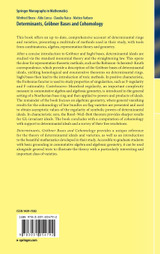
This book offers an up-to-date, comprehensive account of determinantal rings and varieties, presenting a multitude of methods used in their study, with tools from combinatorics, algebra,...
This self-contained monograph is the first to feature the intersection of the structure theory of noncommutative associative algebras and the algorithmic aspect of Groebner basis theory. A double...
This volume contains survey articles and original research papers, presenting the state of the art on applying the symbolic approach of Gröbner bases and related methods to differential and...
Discover your next great read at BookLoop, Australiand online bookstore offering a vast selection of titles across various genres and interests. Whether you're curious about what's trending or searching for graphic novels that captivate, thrilling crime and mystery fiction, or exhilarating action and adventure stories, our curated collections have something for every reader. Delve into imaginative fantasy worlds or explore the realms of science fiction that challenge the boundaries of reality. Fans of contemporary narratives will find compelling stories in our contemporary fiction section. Embark on epic journeys with our fantasy and science fiction titles,
Shop Trending Books and New Releases
Explore our new releases for the most recent additions in romance books, fantasy books, graphic novels, crime and mystery books, science fiction books as well as biographies, cookbooks, self help books, tarot cards, fortunetelling and much more. With titles covering current trends, booktok and bookstagram recommendations, and emerging authors, BookLoop remains your go-to local australian bookstore for buying books online across all book genres.
Shop Best Books By Collection
Stay updated with the literary world by browsing our trending books, featuring the latest bestsellers and critically acclaimed works. Explore titles from popular brands like Minecraft, Pokemon, Star Wars, Bluey, Lonely Planet, ABIA award winners, Peppa Pig, and our specialised collection of ADHD books. At BookLoop, we are committed to providing a diverse and enriching reading experience for all.
Sign In
your cart
Your cart is empty
Menu
Search
PRE-SALES
If you have any questions before making a purchase chat with our online operators to get more information.