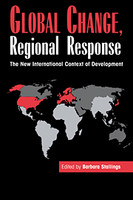
This book offers a new perspective in studying contemporary development. Part I explores how the ending of the cold war, shifting relations among capitalist powers, changing patterns of finance, globalization of trade and production, and new ideological currents have altered development in four major third-world regions. Part II suggests how development options were molded by the dominant international power in each region: the United States in Latin America, Japan in East and Southeast Asia, and Europe with the international financial institutions in Africa. Part III provides a conceptual framework for analyzing regional performance: variation in economic capacity, trade opportunities, and access to finance shaped the development chances of each region, producing rapid growth in Asia, stagnation in Latin America, and economic contraction in sub-Saharan Africa during the 1980s and early 1990s. It also speculates about future trends based on varying development models.
1. Predicting the Hydrological Effects of Climate Change.- Section I Sensitivity of the Global Hydrosphere Section Summary.- 2. An Introduction to Global Water Dynamics.- 3. Modelling the Biospheric...
Global climatic change will most likely affect natural resources and human living conditions in semiarid regions. This volume presents disciplinary as well as integrative methods to assess these...
In a world characterized by persistent local and regional conflicts, policymakers and professionals in current affairs and security studies are increasingly challenged. From the ongoing war in Yemen...