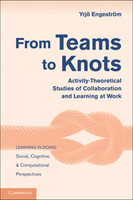
Teams are commonly celebrated as efficient and humane ways of organizing work and learning. By means of a series of in-depth case studies of teams in the United States and Finland over a time span of more than 10 years, this book shows that teams are not a universal and ahistorical form of collaboration. Teams are best understood in their specific activity contexts and embedded in historical development of work. Today, static teams are increasingly replaced by forms of fluid knotworking around runaway objects that require and generate new forms of expansive learning and distributed agency. This book develops a set of conceptual tools for analysis and design of transformations in collaborative work and learning.
Our society holds a very corrupted view of marriage.At the same time that marriage is glamorized by movies and sitcoms, it is devalued by Hollywood and pop culture. Candice Mummert offers a heartfelt...
The Knotty Knot Knots is a children's story book which answers the common question of how it is possible for people's hair to get so knotted up and messy, when they are asleep in bed. Emily is the...
No-nonsense, practical tips for newbie managersAnyone who is stepping up in a role of a manager is surrounded by numerous challenges. The most critical one is to establish himself as a team leader...
Pulitzer Prize winning poet Forrest Gander responds to the provocative photographs of Jack Shear.The elements are timeless and fundamental-a male nude and a piece of black linen-and the photographic...