For more than three decades, all manner of critics of socialist states - non-socialists and socialists alike- have excoriated one of the most unfortunate consequences of the Stalinist-style command economy: its proclivity to favor heavy industry over other economic sectors. Ironically, these systems set up in the name of "the people's" interest shortchanged their constituents' livelihood, as factories and foundries spewed out an endless stream of machinery and metals at the expense of consumer items and daily necessities.In the late 197o's, after the death of Mao Zedong, Chinese leaders were able openly and soberly to scrutinize their faltering industrial system. Under the determined leadership of Deng Xiaoping, they quickly altered the proportions of industrial output in favor of consumer goods. The Chinese leaders had two chief economic goals: to increase the financial returns to the central government and to lay the foundation for a reoriented future pattern of national growth that would give China a secure niche in world markets. They also hoped to open up new employment channels and to meet mass needs for consumer goods. This study shows why and how these goals were chosen and spells out how they were realized.Though there is no evidence of conscious borrowing, in its vision and tactics the agenda the Chinese leaders chose was highly resonant with what is elsewhere labeled "industrial policy." For this reason, the book draws on the literature of industrial policy in France and Japan, where this form of policy first took root, rather than adopting the more conventional model of comparative communism.The book uncovers striking similarities between China's post-1979 plan and what occurred in France and Japan after World War II, at the level of elite perception and goals and in societal, behavioral terms. These similar conditions- in context, decision-making pattern, and implementation style provide the framework of analysis for this volume, a framework that could be applied to ex-colonial and dependent Third World economies as well as to more authoritarian socialist planning systems.
For more than three decades, all manner of critics of socialist states - non-socialists and socialists alike- have excoriated one of the most unfortunate consequences of the Stalinist-style command economy: its proclivity to favor heavy industry over other economic sectors. Ironically, these systems set up in the name of "the people's" interest shortchanged their constituents' livelihood, as factories and foundries spewed out an endless stream of machinery and metals at the expense of consumer items and daily necessities.In the late 197o's, after the death of Mao Zedong, Chinese leaders were able openly and soberly to scrutinize their faltering industrial system. Under the determined leadership of Deng Xiaoping, they quickly altered the proportions of industrial output in favor of consumer goods. The Chinese leaders had two chief economic goals: to increase the financial returns to the central government and to lay the foundation for a reoriented future pattern of national growth that would give China a secure niche in world markets. They also hoped to open up new employment channels and to meet mass needs for consumer goods. This study shows why and how these goals were chosen and spells out how they were realized.Though there is no evidence of conscious borrowing, in its vision and tactics the agenda the Chinese leaders chose was highly resonant with what is elsewhere labeled "industrial policy." For this reason, the book draws on the literature of industrial policy in France and Japan, where this form of policy first took root, rather than adopting the more conventional model of comparative communism.The book uncovers striking similarities between China's post-1979 plan and what occurred in France and Japan after World War II, at the level of elite perception and goals and in societal, behavioral terms. These similar conditions- in context, decision-making pattern, and implementation style provide the framework of analysis for this volume, a framework that could be applied to ex-colonial and dependent Third World economies as well as to more authoritarian socialist planning systems.
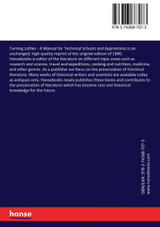
Turning Lathes - A Manual for Technical Schools and Apprentices is an unchanged, high-quality reprint of the original edition of 1890.Hansebooks is editor of the literature on different topic areas...
In this comprehensive guide to lathe-work, Paul Nooncree Hasluck covers a range of tools, appliances, and processes used in the art of turning. Whether you're a novice or an experienced craftsman,...
Discover your next great read at BookLoop, Australiand online bookstore offering a vast selection of titles across various genres and interests. Whether you're curious about what's trending or searching for graphic novels that captivate, thrilling crime and mystery fiction, or exhilarating action and adventure stories, our curated collections have something for every reader. Delve into imaginative fantasy worlds or explore the realms of science fiction that challenge the boundaries of reality. Fans of contemporary narratives will find compelling stories in our contemporary fiction section. Embark on epic journeys with our fantasy and science fiction titles,
Shop Trending Books and New Releases
Explore our new releases for the most recent additions in romance books, fantasy books, graphic novels, crime and mystery books, science fiction books as well as biographies, cookbooks, self help books, tarot cards, fortunetelling and much more. With titles covering current trends, booktok and bookstagram recommendations, and emerging authors, BookLoop remains your go-to local australian bookstore for buying books online across all book genres.
Shop Best Books By Collection
Stay updated with the literary world by browsing our trending books, featuring the latest bestsellers and critically acclaimed works. Explore titles from popular brands like Minecraft, Pokemon, Star Wars, Bluey, Lonely Planet, ABIA award winners, Peppa Pig, and our specialised collection of ADHD books. At BookLoop, we are committed to providing a diverse and enriching reading experience for all.
Sign In
your cart
Your cart is empty
Menu
Search
PRE-SALES
If you have any questions before making a purchase chat with our online operators to get more information.