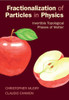

This book explores the fractionalization of particles in physics, how interactions between individual particles and with their background can modify their fundamental quantum states. Covering a large breadth of topics with an example-driven approach, this comprehensive text explains why phases of matter must be described in terms of both symmetries and their topology. The majority of important results are derived in full with explanations provided, while exercises at the end of each section allow readers to extend and develop their understanding of key topics. The first part presents polyacetylene as the paradigmatic material in which electric charge can be fractionalized, while the second part introduces the notion of invertible topological phases of matter. The final part is devoted to the 'ten-fold way', a classification of topological insulators or superconductors. The text requires a solid understanding of quantum mechanics and is a valuable resource for graduate students and researchers in physics.
An accessible and carefully structured introduction to Particle Physics, including important coverage of the Higgs Boson and recent progress in neutrino physics. Fourth edition of this successful...
Fractional calculus is a collection of relatively little-known mathematical results concerning generalizations of differentiation and integration to noninteger orders. While these results have been...
History of Weak Interactions; T.D. Lee. Physics at LEP; L. Foà. Electroweak Precision Tests; R. Barbieri. Chiral Perturbation Theory; G. Ecker. CP- and T-Violations in the Standard Model; J.M...