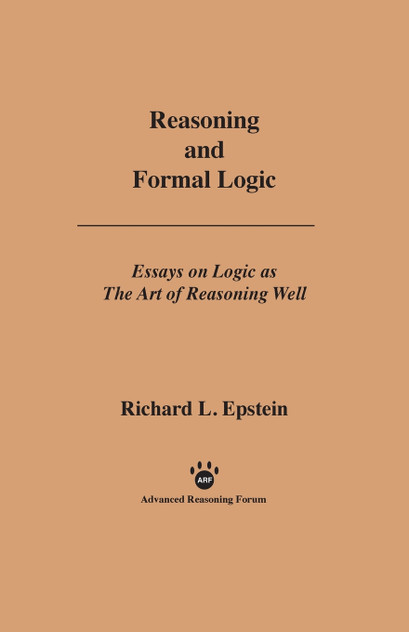
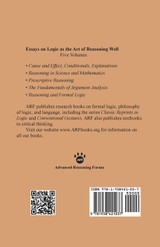
This text, volume II of a two-volume work, examines in depth the so-called “standard” predicate logic. Including a foundational lexicon of terms and a detour through the classical propositional logic, this volume can be used independently of the first.
As a means toward teasing out theoretical subtleties and negotiating formal and philosophic challenges, this work uses detailed examples and exercises; because of this feature, the text can also be used to study formal logic in a rigorous fashion.
Given its expressive power, predicate logic is deemed as minimally adequate for formalization of such fundamental languages as that of Mathematics and for translations of the meanings of English (or other natural-language) sentences. Laying foundations in this area is key to a technical understanding of deductive reasoning and to honing rigorous critical thinking and problem-solving skills.
Notable (some of them unusual) features that are covered in the present volume include the following:
The overview of propositional logic includes positive semantic trees, in addition to the negative semantic tree method.
Prenex forms and conversion to equivalent prenex forms.
Relational (ultimately polyadic) predicate symbols, function symbols and identity are made available.
The decision problem and the Lӧwenheim Result are discussed.
Proof-theoretic methods are presented analytically and extensive justifications are offered for the required restrictions on the deduction rules.
The semantics of predicate logic modeling are presented in analytical detail along with inquiries into the logical-philosophical significance of predicate logic.
Translation from English into the predicate logic idiom (formalization, symbolization) is examined thoroughly, accompanied by motivating linguistic observations and thorough scrutiny of available options; aspects of this inquiry include translations under restricted and unrestricted domains, translations of compacted predicates, rendering of non-classically quantified phrases, translations of numerical statements, definite descriptions and regimentation, and guidance on how to render existential presuppositions.
Disambiguation is imposed on translations and an extensive list of examples is presented.
Translations of idiomatic linguistic expressions are studied.
Semantic tree decision procedures (for finitarian domains) – including negative and positive semantic tree systems – are constructed and applied.
Appendices on Set Theory, Mathematical Induction and Dialogical Logic are presented.
This text, volume II of a two-volume work, examines in depth the so-called “standard” predicate logic. Including a foundational lexicon of terms and a detour through the classical propositional logic, this volume can be used independently of the first.
As a means toward teasing out theoretical subtleties and negotiating formal and philosophic challenges, this work uses detailed examples and exercises; because of this feature, the text can also be used to study formal logic in a rigorous fashion.
Given its expressive power, predicate logic is deemed as minimally adequate for formalization of such fundamental languages as that of Mathematics and for translations of the meanings of English (or other natural-language) sentences. Laying foundations in this area is key to a technical understanding of deductive reasoning and to honing rigorous critical thinking and problem-solving skills.
Notable (some of them unusual) features that are covered in the present volume include the following:
The overview of propositional logic includes positive semantic trees, in addition to the negative semantic tree method.
Prenex forms and conversion to equivalent prenex forms.
Relational (ultimately polyadic) predicate symbols, function symbols and identity are made available.
The decision problem and the Lӧwenheim Result are discussed.
Proof-theoretic methods are presented analytically and extensive justifications are offered for the required restrictions on the deduction rules.
The semantics of predicate logic modeling are presented in analytical detail along with inquiries into the logical-philosophical significance of predicate logic.
Translation from English into the predicate logic idiom (formalization, symbolization) is examined thoroughly, accompanied by motivating linguistic observations and thorough scrutiny of available options; aspects of this inquiry include translations under restricted and unrestricted domains, translations of compacted predicates, rendering of non-classically quantified phrases, translations of numerical statements, definite descriptions and regimentation, and guidance on how to render existential presuppositions.
Disambiguation is imposed on translations and an extensive list of examples is presented.
Translations of idiomatic linguistic expressions are studied.
Semantic tree decision procedures (for finitarian domains) – including negative and positive semantic tree systems – are constructed and applied.
Appendices on Set Theory, Mathematical Induction and Dialogical Logic are presented.
This series of books presents the fundamentals of logic in a style accessible to both students and scholars. The text of each essay presents a story, the main line of development of the ideas, while...
Formal logic provides us with a powerful set of techniques for criticizing some arguments and showing others to be valid. These techniques are relevant to all of us with an interest in being skilful...
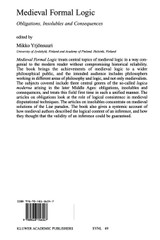
Central topics in medieval logic are here treated in a way that is congenial to the modern reader, without compromising historical reliability. The achievements of medieval logic are made available...
Discover your next great read at BookLoop, Australiand online bookstore offering a vast selection of titles across various genres and interests. Whether you're curious about what's trending or searching for graphic novels that captivate, thrilling crime and mystery fiction, or exhilarating action and adventure stories, our curated collections have something for every reader. Delve into imaginative fantasy worlds or explore the realms of science fiction that challenge the boundaries of reality. Fans of contemporary narratives will find compelling stories in our contemporary fiction section. Embark on epic journeys with our fantasy and science fiction titles,
Shop Trending Books and New Releases
Explore our new releases for the most recent additions in romance books, fantasy books, graphic novels, crime and mystery books, science fiction books as well as biographies, cookbooks, self help books, tarot cards, fortunetelling and much more. With titles covering current trends, booktok and bookstagram recommendations, and emerging authors, BookLoop remains your go-to local australian bookstore for buying books online across all book genres.
Shop Best Books By Collection
Stay updated with the literary world by browsing our trending books, featuring the latest bestsellers and critically acclaimed works. Explore titles from popular brands like Minecraft, Pokemon, Star Wars, Bluey, Lonely Planet, ABIA award winners, Peppa Pig, and our specialised collection of ADHD books. At BookLoop, we are committed to providing a diverse and enriching reading experience for all.
Sign In
your cart
Your cart is empty
Menu
Search
PRE-SALES
If you have any questions before making a purchase chat with our online operators to get more information.