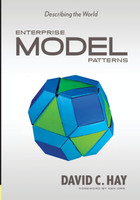
Here you’ll find one key to the development of a successful information system: Clearly capture and communicate both the abstract and concrete building blocks of data that describe your organization.
In 1995, David Hay published Data Model Patterns: Conventions of Thought - the groundbreaking book on how to use standard data models to describe the standard business situations. Enterprise Model Patterns: Describing the World builds on the concepts presented there, adds 15 years of practical experience, and presents a more comprehensive view.
You will learn how to apply both the abstract and concrete elements of your enterprise’s architectural data model through four levels of abstraction:
Level 0: An abstract template that underlies the Level 1 model that follows, plus two meta models:
Information Resources. In addition to books, articles, and e-mail notes, it also includes photographs, videos, and sound recordings.
Accounting. Accounting is remarkable because it is itself a modeling language. It takes a very different approach than data modelers in that instead of using entities and entity classes that represent things in the world, it is concerned with accountsthat represent bits of value to the organization.
Level 1: Anenterprise modelthat is generic enough to apply to any company or government agency, but concrete enough to be readily understood by all. It describes:
People and Organization. Who is involved with the business? The people involved are not only the employees within the organization, but customers, agents, and others with whom the organization comes in contact. Organizations of interest include the enterprise itself and its own internal departments, as well as customers, competitors, government agencies, and the like.
Geographic Locations. Where is business conducted? A geographic location may be either a geographic area (defined as any bounded area on the Earth), a geographic point (used to identify a particular location), or, if you are an oil company for example, a geographic solid (such as an oil reserve).
Assets. What tangible items are used to carry out the business? These are any physical things that are manipulated, sometimes as products, but also as the means to producing products and services.
Activities. How is the business carried out? This model not only covers services offered, but also projects and any other kinds of activities. In addition, the model describes the events that cause activities to happen.
Time. All data is positioned in time, but some more than others.
Level 2: A more detailed model describing specific functional areas:
Facilities
Human Resources
Communications and Marketing
Contracts
Manufacturing
The Laboratory
Level 3: Examples of the details a model can have to address what is trulyunique in a particular industry.
Here you’ll find one key to the development of a successful information system: Clearly capture and communicate both the abstract and concrete building blocks of data that describe your organization.
In 1995, David Hay published Data Model Patterns: Conventions of Thought - the groundbreaking book on how to use standard data models to describe the standard business situations. Enterprise Model Patterns: Describing the World builds on the concepts presented there, adds 15 years of practical experience, and presents a more comprehensive view.
You will learn how to apply both the abstract and concrete elements of your enterprise’s architectural data model through four levels of abstraction:
Level 0: An abstract template that underlies the Level 1 model that follows, plus two meta models:
Information Resources. In addition to books, articles, and e-mail notes, it also includes photographs, videos, and sound recordings.
Accounting. Accounting is remarkable because it is itself a modeling language. It takes a very different approach than data modelers in that instead of using entities and entity classes that represent things in the world, it is concerned with accountsthat represent bits of value to the organization.
Level 1: Anenterprise modelthat is generic enough to apply to any company or government agency, but concrete enough to be readily understood by all. It describes:
People and Organization. Who is involved with the business? The people involved are not only the employees within the organization, but customers, agents, and others with whom the organization comes in contact. Organizations of interest include the enterprise itself and its own internal departments, as well as customers, competitors, government agencies, and the like.
Geographic Locations. Where is business conducted? A geographic location may be either a geographic area (defined as any bounded area on the Earth), a geographic point (used to identify a particular location), or, if you are an oil company for example, a geographic solid (such as an oil reserve).
Assets. What tangible items are used to carry out the business? These are any physical things that are manipulated, sometimes as products, but also as the means to producing products and services.
Activities. How is the business carried out? This model not only covers services offered, but also projects and any other kinds of activities. In addition, the model describes the events that cause activities to happen.
Time. All data is positioned in time, but some more than others.
Level 2: A more detailed model describing specific functional areas:
Facilities
Human Resources
Communications and Marketing
Contracts
Manufacturing
The Laboratory
Level 3: Examples of the details a model can have to address what is trulyunique in a particular industry.
You are working very hard, but does it really make a difference? Are you: ● An Enterprise Architect finding your great ideas have a very limited impact on business decisions? ● A Service or UX...
Every enterprise architect faces similar problems when designing and governing the enterprise architecture of a medium to large enterprise. Design patterns are a well-established concept in software...
Gain a deeper understanding of how distributed systems work, as well as which applications and systems are used for specific business domains or industries. This book provides a set of solution...
Discover your next great read at BookLoop, Australiand online bookstore offering a vast selection of titles across various genres and interests. Whether you're curious about what's trending or searching for graphic novels that captivate, thrilling crime and mystery fiction, or exhilarating action and adventure stories, our curated collections have something for every reader. Delve into imaginative fantasy worlds or explore the realms of science fiction that challenge the boundaries of reality. Fans of contemporary narratives will find compelling stories in our contemporary fiction section. Embark on epic journeys with our fantasy and science fiction titles,
Shop Trending Books and New Releases
Explore our new releases for the most recent additions in romance books, fantasy books, graphic novels, crime and mystery books, science fiction books as well as biographies, cookbooks, self help books, tarot cards, fortunetelling and much more. With titles covering current trends, booktok and bookstagram recommendations, and emerging authors, BookLoop remains your go-to local australian bookstore for buying books online across all book genres.
Shop Best Books By Collection
Stay updated with the literary world by browsing our trending books, featuring the latest bestsellers and critically acclaimed works. Explore titles from popular brands like Minecraft, Pokemon, Star Wars, Bluey, Lonely Planet, ABIA award winners, Peppa Pig, and our specialised collection of ADHD books. At BookLoop, we are committed to providing a diverse and enriching reading experience for all.
Sign In
your cart
Your cart is empty
Menu
Search
PRE-SALES
If you have any questions before making a purchase chat with our online operators to get more information.