Case Study from the year 2015 in the subject English Language and Literature Studies - Linguistics, grade: 1,7, University of Bonn, course: English Words: Structure, History and Usage, language: English, abstract: The history of the English lexicography offers through its numerous works that have survived up to our days a great opportunity to observe not only the semantic development of words, but also their layout in a page, from their fonts' styles and sizes to the structure of their meanings and the later acquisition symbols and abbreviations. Online availability of historical dictionaries enables us to study comparatively and diachronically the curriculum vitae of words, through which we can reconstruct a morpho-semantic overview that links past with present usages and meanings including their semantic development (e.g. polysemy, shifted meanings etc.), spelling variations, etymological suggestions and other valuable pieces of information. In many cases, due to the scientific achievements and rapid changes that occur in the human societies, it is possible to observe how social and cultural changes may have been captured within a particular definition or an etymological explanation.The current study focuses on the analysis of four dictionary entries. How do the meanings of the selected words evolve semantically and what does each lexicographer offer to the reader as we approach modern times? Due to the restricted length available for this paper, the early seventeenth century has been set as starting point for this work; more precisely Robert Cawdrey's Table Alphabeticall (1604), a most well-known work regarded today as the first monolingual English dictionary. A total of ten important dictionaries up to the digital OED will be used. The aim is to demonstrate through a comparative approach what semantic changes have taken place throughout the definitions, what has survived or become obsolete over time and what is the semantic status of today's definitions within
English lexicography through the ages. A case study based on four dictionary entries
RRP:
$73.00
Description
Case Study from the year 2015 in the subject English Language and Literature Studies - Linguistics, grade: 1,7, University of Bonn, course: English Words: Structure, History and Usage, language: English, abstract: The history of the English lexicography offers through its numerous works that have survived up to our days a great opportunity to observe not only the semantic development of words, but also their layout in a page, from their fonts' styles and sizes to the structure of their meanings and the later acquisition symbols and abbreviations. Online availability of historical dictionaries enables us to study comparatively and diachronically the curriculum vitae of words, through which we can reconstruct a morpho-semantic overview that links past with present usages and meanings including their semantic development (e.g. polysemy, shifted meanings etc.), spelling variations, etymological suggestions and other valuable pieces of information. In many cases, due to the scientific achievements and rapid changes that occur in the human societies, it is possible to observe how social and cultural changes may have been captured within a particular definition or an etymological explanation.The current study focuses on the analysis of four dictionary entries. How do the meanings of the selected words evolve semantically and what does each lexicographer offer to the reader as we approach modern times? Due to the restricted length available for this paper, the early seventeenth century has been set as starting point for this work; more precisely Robert Cawdrey's Table Alphabeticall (1604), a most well-known work regarded today as the first monolingual English dictionary. A total of ten important dictionaries up to the digital OED will be used. The aim is to demonstrate through a comparative approach what semantic changes have taken place throughout the definitions, what has survived or become obsolete over time and what is the semantic status of today's definitions within
Dictionaries are among the most frequently consulted books, yet we know remarkably little about them. Who makes them? Where do they come from? What do they offer? How can we evaluate them?The...
The evolution of English lexicography, is many of the old classic books which have been considered important throughout the human history. They are now extremely scarce and very expensive antique. So...
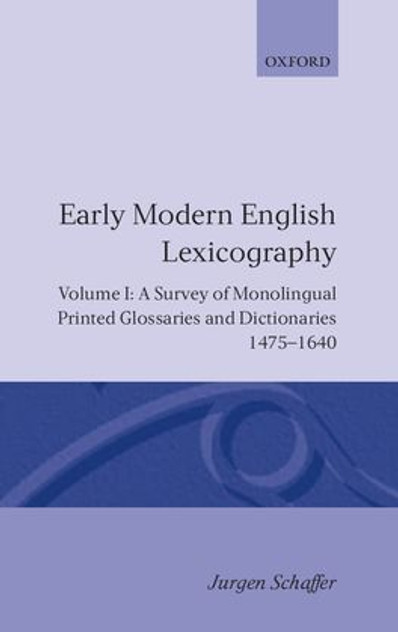
Early Modern English Lexicography presents for the first time a census of printed monolingual glossaries and dictionaries published from 1475 to 1640, together with a systematic bibliographical...
Discover your next great read at BookLoop, Australiand online bookstore offering a vast selection of titles across various genres and interests. Whether you're curious about what's trending or searching for graphic novels that captivate, thrilling crime and mystery fiction, or exhilarating action and adventure stories, our curated collections have something for every reader. Delve into imaginative fantasy worlds or explore the realms of science fiction that challenge the boundaries of reality. Fans of contemporary narratives will find compelling stories in our contemporary fiction section. Embark on epic journeys with our fantasy and science fiction titles,
Shop Trending Books and New Releases
Explore our new releases for the most recent additions in romance books, fantasy books, graphic novels, crime and mystery books, science fiction books as well as biographies, cookbooks, self help books, tarot cards, fortunetelling and much more. With titles covering current trends, booktok and bookstagram recommendations, and emerging authors, BookLoop remains your go-to local australian bookstore for buying books online across all book genres.
Shop Best Books By Collection
Stay updated with the literary world by browsing our trending books, featuring the latest bestsellers and critically acclaimed works. Explore titles from popular brands like Minecraft, Pokemon, Star Wars, Bluey, Lonely Planet, ABIA award winners, Peppa Pig, and our specialised collection of ADHD books. At BookLoop, we are committed to providing a diverse and enriching reading experience for all.
Sign In
your cart
Your cart is empty
Menu
Search
PRE-SALES
If you have any questions before making a purchase chat with our online operators to get more information.