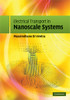
In recent years there has been a huge increase in the research and development of nanoscale science and technology. Central to the understanding of the properties of nanoscale structures is the modeling of electronic conduction through these systems. This graduate textbook provides an in-depth description of the transport phenomena relevant to systems of nanoscale dimensions. In this textbook the different theoretical approaches are critically discussed, with emphasis on their basic assumptions and approximations. The book also covers information content in the measurement of currents, the role of initial conditions in establishing a steady state, and the modern use of density-functional theory. Topics are introduced by simple physical arguments, with particular attention to the non-equilibrium statistical nature of electrical conduction, and followed by a detailed formal derivation. This textbook is ideal for graduate students in physics, chemistry, and electrical engineering.
Transportation systems play a major role in the reduction of energy consumptions and environmental impact all over the world. The significant amount of energy of transport systems forces the adoption...
Allows the reader to deepen their understanding of various technologies for both fixed power supply installations of railway systems and for railway rolling stock This book explores the electric...
This thesis demonstrates how molecular modeling techniques can be used to gain significant insights into numerous applications that are increasingly attracting research interest because of their...