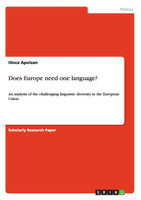
Research Paper (undergraduate) from the year 2008 in the subject Politics - International Politics - Topic: European Union, grade: 2,3, Fontys University of Applied Sciences Venlo, course: European Studies, language: English, abstract: Today the European Union (EU) is home to 497 million people from diverse ethnic, cultural and linguistic backgrounds. The Union is the only organization that unifies so many different countries, more precisely 23 official languages and 27 European nations (Zimmer 2007, p. 20). Driven by the common idea of creating a democratic community and a globally competitive market, the EU strongly corroborates equality of every nation's culture, values and languages. Nevertheless the EU is currently struggling with the discrepancy between cultural and linguistic diversity and the equal integration of every member state. Additionally, the emerging English, as the international lingua franca, seems to put a strain on the peaceful cooperation of all 23 official languages. In view of this unfortunate development the question aroused if Europe needs one common language.The first two segments of chapter 2 are to give an overview of the linguistic situation and the official language arrangements of the EU. The following segment describes the contentious situation of the EU, caused by superior number of languages, high costs and the actual inequality of some official languages. In the first subsection of chapter 3 several reason for adopting only one official language are determined. Thereupon the languages Latin, Esperanto and English are analyzed to examine if one of them is able to function as the European lingua franca. In the last part of chapter 3 a short conclusion on monolingualism is drawn and the effects on the functioning of the EU explained. Based on the previous formulated conclusion, the first segment of chapter 4 for will sum up main reasons for maintaining the European language diversity. In addition the positive attitude of the EU to
Research Paper (undergraduate) from the year 2008 in the subject Politics - International Politics - Topic: European Union, grade: 2,3, Fontys University of Applied Sciences Venlo, course: European Studies, language: English, abstract: Today the European Union (EU) is home to 497 million people from diverse ethnic, cultural and linguistic backgrounds. The Union is the only organization that unifies so many different countries, more precisely 23 official languages and 27 European nations (Zimmer 2007, p. 20). Driven by the common idea of creating a democratic community and a globally competitive market, the EU strongly corroborates equality of every nation's culture, values and languages. Nevertheless the EU is currently struggling with the discrepancy between cultural and linguistic diversity and the equal integration of every member state. Additionally, the emerging English, as the international lingua franca, seems to put a strain on the peaceful cooperation of all 23 official languages. In view of this unfortunate development the question aroused if Europe needs one common language.The first two segments of chapter 2 are to give an overview of the linguistic situation and the official language arrangements of the EU. The following segment describes the contentious situation of the EU, caused by superior number of languages, high costs and the actual inequality of some official languages. In the first subsection of chapter 3 several reason for adopting only one official language are determined. Thereupon the languages Latin, Esperanto and English are analyzed to examine if one of them is able to function as the European lingua franca. In the last part of chapter 3 a short conclusion on monolingualism is drawn and the effects on the functioning of the EU explained. Based on the previous formulated conclusion, the first segment of chapter 4 for will sum up main reasons for maintaining the European language diversity. In addition the positive attitude of the EU to
Our society views ADHD, Oppositional Defiance Disorder, and other labels as a way of judging parents. There is more to learn about these types of behaviours, but the judgment and toxicity our society...
Hugo doesn't think he needs to read. He's sure of it actually. He gets by just fine without it, no matter what his parents say. His mom reads to him all the time anyway, and when she's not around, he...
This work has been selected by scholars as being culturally important, and is part of the knowledge base of civilization as we know it. This work was reproduced from the original artifact, and...
Does Civilization Need Religion? sets out from the fact that religion's inability to make its ethical and social resources available for the solution of the moral problems of modern civilization is...
Discover your next great read at BookLoop, Australiand online bookstore offering a vast selection of titles across various genres and interests. Whether you're curious about what's trending or searching for graphic novels that captivate, thrilling crime and mystery fiction, or exhilarating action and adventure stories, our curated collections have something for every reader. Delve into imaginative fantasy worlds or explore the realms of science fiction that challenge the boundaries of reality. Fans of contemporary narratives will find compelling stories in our contemporary fiction section. Embark on epic journeys with our fantasy and science fiction titles,
Shop Trending Books and New Releases
Explore our new releases for the most recent additions in romance books, fantasy books, graphic novels, crime and mystery books, science fiction books as well as biographies, cookbooks, self help books, tarot cards, fortunetelling and much more. With titles covering current trends, booktok and bookstagram recommendations, and emerging authors, BookLoop remains your go-to local australian bookstore for buying books online across all book genres.
Shop Best Books By Collection
Stay updated with the literary world by browsing our trending books, featuring the latest bestsellers and critically acclaimed works. Explore titles from popular brands like Minecraft, Pokemon, Star Wars, Bluey, Lonely Planet, ABIA award winners, Peppa Pig, and our specialised collection of ADHD books. At BookLoop, we are committed to providing a diverse and enriching reading experience for all.
Sign In
your cart
Your cart is empty
Menu
Search
PRE-SALES
If you have any questions before making a purchase chat with our online operators to get more information.