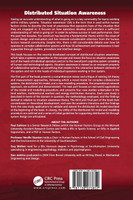
Having an accurate understanding of what is going on is a key commodity for teams working within military systems. 'Situation awareness' (SA) is the term that is used within human factors circles to describe the level of awareness that operators have of the situation that they are engaged in; it focuses on how operators develop and maintain a sufficient understanding of 'what is going on' in order to achieve success in task performance. Over the past two decades, the construct has become a fundamental theme within the areas of system design and evaluation and has received considerable attention from the human factors research community. Despite this, there is still considerable debate over how SA operates in complex collaborative systems and how SA achievement and maintenance is best supported through system, procedure and interface design. This book focuses on the recently developed concept of distributed situation awareness, which takes a systems perspective on the concept and moves the focus on situation awareness out of the heads of individual operators and on to the overall joint cognitive system consisting of human and technological agents. Situation awareness is viewed as an emergent property of collaborative systems, something that resides in the interaction between elements of the system and not in the heads of individual operators working in that system. The first part of the book presents a comprehensive review and critique of existing SA theory and measurement approaches, following which a novel model for complex collaborative systems, the distributed SA model, and a new modelling procedure, the propositional network approach, are outlined and demonstrated. The next part focuses on real-world applications of the model and modelling procedure, and presents four case studies undertaken in the land warfare, multinational warfare and energy distribution domains. Each case study is described in terms of the domain in question, the methodology employed, and the findings derived in relation to situation awareness theory. The third and final part of the book then concentrates on theoretical development, and uses the academic literature and the findings from the case study applications to validate and extend the distributed SA model described at the beginning of the book. In closing, the utility of the distributed SA model and modeling procedure are outlined and a series of initial guidelines for supporting distributed SA through system design are articulated.
Having an accurate understanding of what is going on is a key commodity for teams working within military systems. 'Situation awareness' (SA) is the term that is used within human factors circles to describe the level of awareness that operators have of the situation that they are engaged in; it focuses on how operators develop and maintain a sufficient understanding of 'what is going on' in order to achieve success in task performance. Over the past two decades, the construct has become a fundamental theme within the areas of system design and evaluation and has received considerable attention from the human factors research community. Despite this, there is still considerable debate over how SA operates in complex collaborative systems and how SA achievement and maintenance is best supported through system, procedure and interface design. This book focuses on the recently developed concept of distributed situation awareness, which takes a systems perspective on the concept and moves the focus on situation awareness out of the heads of individual operators and on to the overall joint cognitive system consisting of human and technological agents. Situation awareness is viewed as an emergent property of collaborative systems, something that resides in the interaction between elements of the system and not in the heads of individual operators working in that system. The first part of the book presents a comprehensive review and critique of existing SA theory and measurement approaches, following which a novel model for complex collaborative systems, the distributed SA model, and a new modelling procedure, the propositional network approach, are outlined and demonstrated. The next part focuses on real-world applications of the model and modelling procedure, and presents four case studies undertaken in the land warfare, multinational warfare and energy distribution domains. Each case study is described in terms of the domain in question, the methodology employed, and the findings derived in relation to situation awareness theory. The third and final part of the book then concentrates on theoretical development, and uses the academic literature and the findings from the case study applications to validate and extend the distributed SA model described at the beginning of the book. In closing, the utility of the distributed SA model and modeling procedure are outlined and a series of initial guidelines for supporting distributed SA through system design are articulated.
In recent years, the global climate has become variable due to intensification of the greenhouse effect, and natural disasters are frequently occurring, which poses challenges to the situation...
Motivation for the Book This book seeks to establish the state of the art in the cyber situational awareness area and to set the course for future research. A multidisciplinary group of leading...
Discover your next great read at BookLoop, Australiand online bookstore offering a vast selection of titles across various genres and interests. Whether you're curious about what's trending or searching for graphic novels that captivate, thrilling crime and mystery fiction, or exhilarating action and adventure stories, our curated collections have something for every reader. Delve into imaginative fantasy worlds or explore the realms of science fiction that challenge the boundaries of reality. Fans of contemporary narratives will find compelling stories in our contemporary fiction section. Embark on epic journeys with our fantasy and science fiction titles,
Shop Trending Books and New Releases
Explore our new releases for the most recent additions in romance books, fantasy books, graphic novels, crime and mystery books, science fiction books as well as biographies, cookbooks, self help books, tarot cards, fortunetelling and much more. With titles covering current trends, booktok and bookstagram recommendations, and emerging authors, BookLoop remains your go-to local australian bookstore for buying books online across all book genres.
Shop Best Books By Collection
Stay updated with the literary world by browsing our trending books, featuring the latest bestsellers and critically acclaimed works. Explore titles from popular brands like Minecraft, Pokemon, Star Wars, Bluey, Lonely Planet, ABIA award winners, Peppa Pig, and our specialised collection of ADHD books. At BookLoop, we are committed to providing a diverse and enriching reading experience for all.
Sign In
your cart
Your cart is empty
Menu
Search
PRE-SALES
If you have any questions before making a purchase chat with our online operators to get more information.