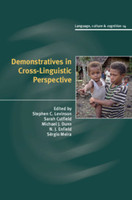
Demonstratives play a crucial role in the acquisition and use of language. Bringing together a team of leading scholars this detailed study, a first of its kind, explores meaning and use across fifteen typologically and geographically unrelated languages to find out what cross-linguistic comparisons and generalizations can be made, and how this might challenge current theory in linguistics, psychology, anthropology and philosophy. Using a shared experimental task, rounded out with studies of natural language use, specialists in each of the languages undertook extensive fieldwork for this comparative study of semantics and usage. An introduction summarizes the shared patterns and divergences in meaning and use that emerge.
This book of new research by leading experts expands our current understanding of the ways in which languages allow for ellipsis of the sluicing type to occur, and shows how sluicing constructions...
Recent studies in psycho linguistics have ranged through a variety of languages. In this trend, which has no precedent, studies in language processing have followed studies in language acquisition...
The typological, contrastive, and descriptive studies in this volume investigate the strategies employed by the world's languages to create complex denotations by combining two noun-like elements,...