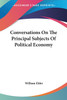
Published at a pivotal moment in the economic development of Britain, Conversations on Political Economy (1816) influenced a generation of economists, politicians and intellectuals. Employing her trademark format of dialogues between Mrs. Bryan and her pupil Caroline, Marcet introduces readers to theories surrounding property, population, and the 'condition of the poor'. Despite a target audience of young women, there is little evidence of feminine sentimentality, nor does the author's commitment to female education prevent her from propounding challenging, often controversial arguments; an approach which won her admiration. As one of her avid readers, Anne Romilly wrote, 'those, who like me know very little ... are delighted with the knowledge they have acquired'. In fact, the first edition was so well received that a second was called for before the author had time to make corrections. Marcet had become, as one of her obituarists later put it, the 'instructress of a generation'.
This scarce antiquarian book is a facsimile reprint of the original. Due to its age, it may contain imperfections such as marks, notations, marginalia and flawed pages. Because we believe this work...
This work has been selected by scholars as being culturally important, and is part of the knowledge base of civilization as we know it.This work is in the "public domain in the United States of...
Citing Marx's socioeconomic base/social superstructure metaphor, Norman Markel proposes that "conversation style" is a social superstructure that reproduces and reinforces a socioeconomic base...