Trending Bestseller

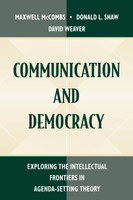
Communication and Democracy

Exploring the intellectual Frontiers in Agenda-setting theory

Maxwell E. McCombs

No reviews yet Write a Review
Paperback / softback
01 June 1997
$113.00
Ships in 3-5 business days
Hurry up! Current stock:
Exciting intellectual frontiers are open for exploration as agenda-setting theory moves beyond its 25th anniversary. This volume offers an intriguing set of maps to guide this exploration over the near future. It is intended for those who are already reasonably well read in the research literature that has accumulated since the publication of McCombs and Shaw's original 1972 Public Opinion Quarterly article. This piece of literature documented the influence of the news media agenda on the public agenda in a wide variety of geographic and social settings, elaborated the characteristics of audiences and media that enhance or diminish those agenda-setting effects, and cataloged those exogenous factors explaining who sets the media's agenda. In the current volume, a provocative set of maps for explicating new levels of agenda-setting theory have been sketched by a new generation of young scholars, launching an enterprise that has significant implications for theoretical research and for the day-to-day role of mass communication in democratic societies.
At the first level of agenda setting are agendas of objects--the traditional domain of agenda setting research--represented by an accumulation of hundreds of studies over the past quarter century. At the second level of agenda setting are agendas of attributes--one of the new theoretical frontiers whose aspects are discussed in detail in the opening chapters. Other chapters offer maps of yet other theoretical frontiers, including political advertising agendas and their impact on behavior, the framing of various agendas in the mass media and the differential impact of print and TV, the theoretical role of individual differences in the agenda-setting influence of the news media on the public agenda, methodological advances for determining cause and effect roles in agenda-setting, and the application of agenda-setting theory to historical analysis. This volume is an invitation to others to become active members of the invisible college of agenda-setting scholarship. As such, the goals of this book are threefold:
* to introduce a broad set of ideas about agenda-setting;
* to enrich the exploration of these ideas by enhancing scholarly dialogue among the members of this invisible college; and
* to enhance the discussion of agenda-setting research in seminars and research groups around the world.
Agenda-setting has remained a vital and productive area of communication research over a quarter century because it has continued to introduce new research questions into the marketplace of ideas and to integrate this work with other theoretical concepts and perspectives about journalism and mass communication. Understanding the dynamics of agenda- setting is central to understanding the dynamics of contemporary democracy. This book's set of theoretical essays, grounded in the accumulated literature of agenda- setting theory and in the creative insights of young scholars, will help lead the way toward that understanding.

This product hasn't received any reviews yet. Be the first to review this product!

$113.00
Ships in 3-5 business days
Hurry up! Current stock:

Communication and Democracy

$113.00

Description

Exciting intellectual frontiers are open for exploration as agenda-setting theory moves beyond its 25th anniversary. This volume offers an intriguing set of maps to guide this exploration over the near future. It is intended for those who are already reasonably well read in the research literature that has accumulated since the publication of McCombs and Shaw's original 1972 Public Opinion Quarterly article. This piece of literature documented the influence of the news media agenda on the public agenda in a wide variety of geographic and social settings, elaborated the characteristics of audiences and media that enhance or diminish those agenda-setting effects, and cataloged those exogenous factors explaining who sets the media's agenda. In the current volume, a provocative set of maps for explicating new levels of agenda-setting theory have been sketched by a new generation of young scholars, launching an enterprise that has significant implications for theoretical research and for the day-to-day role of mass communication in democratic societies.
At the first level of agenda setting are agendas of objects--the traditional domain of agenda setting research--represented by an accumulation of hundreds of studies over the past quarter century. At the second level of agenda setting are agendas of attributes--one of the new theoretical frontiers whose aspects are discussed in detail in the opening chapters. Other chapters offer maps of yet other theoretical frontiers, including political advertising agendas and their impact on behavior, the framing of various agendas in the mass media and the differential impact of print and TV, the theoretical role of individual differences in the agenda-setting influence of the news media on the public agenda, methodological advances for determining cause and effect roles in agenda-setting, and the application of agenda-setting theory to historical analysis. This volume is an invitation to others to become active members of the invisible college of agenda-setting scholarship. As such, the goals of this book are threefold:
* to introduce a broad set of ideas about agenda-setting;
* to enrich the exploration of these ideas by enhancing scholarly dialogue among the members of this invisible college; and
* to enhance the discussion of agenda-setting research in seminars and research groups around the world.
Agenda-setting has remained a vital and productive area of communication research over a quarter century because it has continued to introduce new research questions into the marketplace of ideas and to integrate this work with other theoretical concepts and perspectives about journalism and mass communication. Understanding the dynamics of agenda- setting is central to understanding the dynamics of contemporary democracy. This book's set of theoretical essays, grounded in the accumulated literature of agenda- setting theory and in the creative insights of young scholars, will help lead the way toward that understanding.

Customers Also Viewed

Buy Books Online at BookLoop

Discover your next great read at BookLoop, Australiand online bookstore offering a vast selection of titles across various genres and interests. Whether you're curious about what's trending or searching for graphic novels that captivate, thrilling crime and mystery fiction, or exhilarating action and adventure stories, our curated collections have something for every reader. Delve into imaginative fantasy worlds or explore the realms of science fiction that challenge the boundaries of reality. Fans of contemporary narratives will find compelling stories in our contemporary fiction section. Embark on epic journeys with our fantasy and science fiction titles,

Shop Trending Books and New Releases

Explore our new releases for the most recent additions in romance books, fantasy books, graphic novels, crime and mystery books, science fiction books as well as biographies, cookbooks, self help books, tarot cards, fortunetelling and much more. With titles covering current trends, booktok and bookstagram recommendations, and emerging authors, BookLoop remains your go-to local australian bookstore for buying books online across all book genres.

Shop Best Books By Collection

Stay updated with the literary world by browsing our trending books, featuring the latest bestsellers and critically acclaimed works. Explore titles from popular brands like Minecraft, Pokemon, Star Wars, Bluey, Lonely Planet, ABIA award winners, Peppa Pig, and our specialised collection of ADHD books. At BookLoop, we are committed to providing a diverse and enriching reading experience for all.