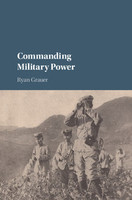
Commanding Military Power offers a new explanation of why some armed forces are stronger than others. Ryan Grauer advances a 'command structure theory' which combines insights from organization theory, international relations, and security studies literatures to provide a unique perspective on military power. Specifically, armed forces organized to facilitate swift and accurate perception of and response to battlefield developments will cope better with war's inherent uncertainty, use resources effectively, and, quite often, win. Case studies of battles from the Russo-Japanese War, Chinese Civil War and Korean War, based on new archival research, underscore the argument, showing that even smaller and materially weaker militaries can fight effectively against and defeat larger and better endowed adversaries when they are organizationally prepared to manage uncertainty. That organization often matters more than numbers and specific tools of war has crucial implications for both contemporary and future thinking about and efforts to improve martial strength.
The BiblioGov Project is an effort to expand awareness of the public documents and records of the U.S. Government via print publications. In broadening the public understanding of government and its...
Public opinion has been recognized as an influential force on the battlefield since Napoleon's days as a commander. Clausewitz refers to the triangle of power as the people, the military, and the...
The Freedom of Information Act (FOIA) is a federal freedom of information law that allows for the full or partial disclosure of previously unreleased information and documents controlled by the...