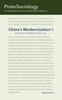
The idea of only one way leading to a modern society seems to be hardly tenable. But even if we agree to this, our theories and terms describing modernization are gained on our own Western history. So social science has to reconsider its basic terms to describe China's modernization, and maybe even the understanding of modernization itself. The first of two volumes on China's modernization, collects articles by leading Chinese and Western scientists focusing on the main conflicts and differences this process involves. In a first section - "Changing China: Dealing with Diversity" -, Björn Alperman analyses the terms "Class, Citizenship and Individualization in China's Modernization". Andrew Kipnis analyses the "Chinese Nation-Building as, Instead of, and Before Globalization", while John R. Gibbins examines "Principles for Cosmopolitan Societies: Values for Cosmopolitan Places"."On Modernization: Law, Business, and Economy in China", the second section, deals with "Modernizing Chinese Law: The Protection of Private Property in China" by Sanzhu Zhu, "Chinese Organizations as Groups of People - Towards a Chinese Business Administration" by Peter J. Peverelli, and "Income Gaps in Economic Development: Differences among Regions, Occupational Groups and Ethnic Groups" by Ma Rong. The last section - "Thinking Differentiations: Chinese Origin and the Western Culture" - concentrates on the role of religion with articles by Richard Madsen ("Christianity and Hybrid Modernity in China") and Thorsten Botz-Bornstein ("Confucianism, Puritanism, and the Transcendental: China and America"). Jeffrey N. Wasserstrom argues that Nathan Sharansky's test for free nations should take regional variations into account in "China and the Town Square Test". In "Metaphor, Poetry and Cultural Implicature" Ying Zhang examines if the Western understanding of metaphor can be transferred to Chinese language and culture. The additional rubric "On Contemporary Philosophy" involves three artic
The idea of only one way leading to a modern society seems to be hardly tenable. But even if we agree to this, our theories and terms describing modernization are gained on our own Western history. So social science has to reconsider its basic terms to describe China's modernization, and maybe even the understanding of modernization itself. The first of two volumes on China's modernization, collects articles by leading Chinese and Western scientists focusing on the main conflicts and differences this process involves. In a first section - "Changing China: Dealing with Diversity" -, Björn Alperman analyses the terms "Class, Citizenship and Individualization in China's Modernization". Andrew Kipnis analyses the "Chinese Nation-Building as, Instead of, and Before Globalization", while John R. Gibbins examines "Principles for Cosmopolitan Societies: Values for Cosmopolitan Places"."On Modernization: Law, Business, and Economy in China", the second section, deals with "Modernizing Chinese Law: The Protection of Private Property in China" by Sanzhu Zhu, "Chinese Organizations as Groups of People - Towards a Chinese Business Administration" by Peter J. Peverelli, and "Income Gaps in Economic Development: Differences among Regions, Occupational Groups and Ethnic Groups" by Ma Rong. The last section - "Thinking Differentiations: Chinese Origin and the Western Culture" - concentrates on the role of religion with articles by Richard Madsen ("Christianity and Hybrid Modernity in China") and Thorsten Botz-Bornstein ("Confucianism, Puritanism, and the Transcendental: China and America"). Jeffrey N. Wasserstrom argues that Nathan Sharansky's test for free nations should take regional variations into account in "China and the Town Square Test". In "Metaphor, Poetry and Cultural Implicature" Ying Zhang examines if the Western understanding of metaphor can be transferred to Chinese language and culture. The additional rubric "On Contemporary Philosophy" involves three artic
Two sharply contrasting views of China exist today. On the one hand a rising superpower predicted to have the largest economy in the world by mid century, on the other hand a brutal, anachronistic...
The idea of only one way leading to a modern society seems to be hardly tenable. But even if we agree to this, our theories and terms describing modernization are gained on our own Western history...
Discover your next great read at BookLoop, Australiand online bookstore offering a vast selection of titles across various genres and interests. Whether you're curious about what's trending or searching for graphic novels that captivate, thrilling crime and mystery fiction, or exhilarating action and adventure stories, our curated collections have something for every reader. Delve into imaginative fantasy worlds or explore the realms of science fiction that challenge the boundaries of reality. Fans of contemporary narratives will find compelling stories in our contemporary fiction section. Embark on epic journeys with our fantasy and science fiction titles,
Shop Trending Books and New Releases
Explore our new releases for the most recent additions in romance books, fantasy books, graphic novels, crime and mystery books, science fiction books as well as biographies, cookbooks, self help books, tarot cards, fortunetelling and much more. With titles covering current trends, booktok and bookstagram recommendations, and emerging authors, BookLoop remains your go-to local australian bookstore for buying books online across all book genres.
Shop Best Books By Collection
Stay updated with the literary world by browsing our trending books, featuring the latest bestsellers and critically acclaimed works. Explore titles from popular brands like Minecraft, Pokemon, Star Wars, Bluey, Lonely Planet, ABIA award winners, Peppa Pig, and our specialised collection of ADHD books. At BookLoop, we are committed to providing a diverse and enriching reading experience for all.
Sign In
your cart
Your cart is empty
Menu
Search
PRE-SALES
If you have any questions before making a purchase chat with our online operators to get more information.