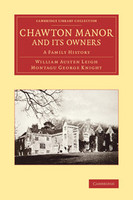
Chawton House is famous today as the home of Jane Austen's brother Edward, who was adopted by a wealthy relative, Thomas Knight, and inherited his Hampshire estate. Edward offered the former bailiff's cottage close to the great house to his mother, who lived there with her unmarried daughters Jane and Cassandra. The house is now a study centre and library, for women's writing especially, but when this book was published in 1911 the building was still the Knight family home. Montagu Knight, the grandson of Edward, supplied material from the archives of the manor, while the book was largely written by his cousin William Austen Leigh, the son of Jane's nephew and memorialist. It covers the history of the manor from the Norman Conquest to the death of the second Edward in 1879, and, apart from the Austen connection, is a fascinating illustrated history of a typical English parish.
This work has been selected by scholars as being culturally important, and is part of the knowledge base of civilization as we know it. This work was reproduced from the original artifact, and...
This scarce antiquarian book is a facsimile reprint of the original. Due to its age, it may contain imperfections such as marks, notations, marginalia and flawed pages. Because we believe this work...
This book has been considered by academicians and scholars of great significance and value to literature. This forms a part of the knowledge base for future generations. We have represented this book...
The thirteen letters collected by Jane Austen's House Museum, in Chawton, give us intimate glimpses into her life in Bath and Chawton and on visits to London, many details finding echoes in her...