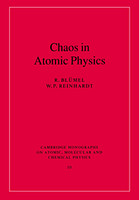
This book describes the manifestations of chaos in atoms and molecules. The study of chaos is today one of the most active and prolific areas in atomic physics. This is the first attempt to provide a coherent introduction to this fascinating area. In line with its scope, the book is divided into two parts. The first part (chapters 1-5) deals with the theory and principles of classical chaos. The ideas developed here are then applied to actual atomic and molecular physics systems in the second part of the book (chapters 6-10) covering microwave driven surface state electrons, the hydrogen atom in a strong microwave field, the kicked hydrogen atom, chaotic scattering with CsI molecules and the helium atom. The book contains many diagrams and a detailed references list.
Background: Introduction.- The Bohr model of the atom.- Numerical values and the fine structure constant.- Atomic dimensions - is a reasonable atomic diameter? .- Localizing the electron: Is a point...
Computational Atomic Physics deals with computational methods for calculating electron (and positron) scattering from atoms and ions, including elastic scattering, excitation, and ionization ...
The problems are judiciously selected and are given topic and section-wise. The approachis straight forward and step-by step solutions are elaborately provided. More importantly therelevant formulas...