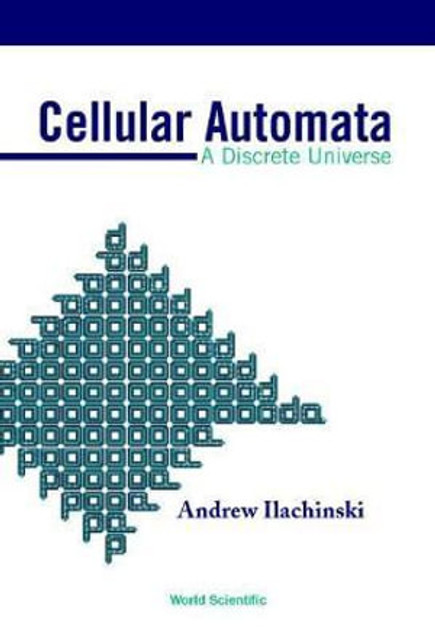
Cellular Automata Transforms describes a new approach to using the dynamical system, popularly known as cellular automata (CA), as a tool for conducting transforms on data. Cellular automata have generated a great deal of interest since the early 1960s when John Conway created the `Game of Life'. This book takes a more serious look at CA by describing methods by which information building blocks, called basis functions (or bases), can be generated from the evolving states. These information blocks can then be used to construct any data. A typical dynamical system such as CA tend to involve an infinite possibilities of rules that define the inherent elements, neighborhood size, shape, number of states, and modes of association, etc. To be able to build these building blocks an elegant method had to be developed to address a large subset of these rules. A new formula, which allows for the definition a large subset of possible rules, is described in the book. The robustness of this formula allows searching of the CA rule space in order to develop applications for multimedia compression, data encryption and process modeling. Cellular Automata Transforms is divided into two parts. In Part I the fundamentals of cellular automata, including the history and traditional applications are outlined. The challenges faced in using CA to solve practical problems are described. The basic theory behind Cellular Automata Transforms (CAT) is developed in this part of the book. Techniques by which the evolving states of a cellular automaton can be converted into information building blocks are taught. The methods (including fast convolutions) by which forward and inverse transforms of any data can be achieved are also presented. Part II contains a description of applications of CAT. Chapter 4 describes digital image compression, audio compression and synthetic audio generation, three approaches for compressing video data. Chapter 5 contains both symmetric and public-key implementation of CAT encryption. Possible methods of attack are also outlined. Chapter 6 looks at process modeling by solving differential and integral equations. Examples are drawn from physics and fluid dynamics.
Cellular Automata Transforms describes a new approach to using the dynamical system, popularly known as cellular automata (CA), as a tool for conducting transforms on data. Cellular automata have generated a great deal of interest since the early 1960s when John Conway created the `Game of Life'. This book takes a more serious look at CA by describing methods by which information building blocks, called basis functions (or bases), can be generated from the evolving states. These information blocks can then be used to construct any data. A typical dynamical system such as CA tend to involve an infinite possibilities of rules that define the inherent elements, neighborhood size, shape, number of states, and modes of association, etc. To be able to build these building blocks an elegant method had to be developed to address a large subset of these rules. A new formula, which allows for the definition a large subset of possible rules, is described in the book. The robustness of this formula allows searching of the CA rule space in order to develop applications for multimedia compression, data encryption and process modeling. Cellular Automata Transforms is divided into two parts. In Part I the fundamentals of cellular automata, including the history and traditional applications are outlined. The challenges faced in using CA to solve practical problems are described. The basic theory behind Cellular Automata Transforms (CAT) is developed in this part of the book. Techniques by which the evolving states of a cellular automaton can be converted into information building blocks are taught. The methods (including fast convolutions) by which forward and inverse transforms of any data can be achieved are also presented. Part II contains a description of applications of CAT. Chapter 4 describes digital image compression, audio compression and synthetic audio generation, three approaches for compressing video data. Chapter 5 contains both symmetric and public-key implementation of CAT encryption. Possible methods of attack are also outlined. Chapter 6 looks at process modeling by solving differential and integral equations. Examples are drawn from physics and fluid dynamics.
Cellular automata are a class of spatially and temporally discrete mathematical systems characterized by local interaction and synchronous dynamical evolution. Introduced by the mathematician John...
This book explores Probabilistic Cellular Automata (PCA) from the perspectives of statistical mechanics, probability theory, computational biology and computer science. PCA are extensions of the...
Are mathematical equations the best way to model nature? For many years it had been assumed that they were. But in the early 1980s, Stephen Wolfram made the radical proposal that one should instead...
The Quantum Cellular Automaton (QCA) concept represents an attempt to break away from the traditional three-terminal device paradigm that has dominated digital computation. Since its early...
Cellular automata were introduced in the first half of the last century by John von Neumann who used them as theoretical models for self-reproducing machines. The authors present a self-contained...
Discover your next great read at BookLoop, Australiand online bookstore offering a vast selection of titles across various genres and interests. Whether you're curious about what's trending or searching for graphic novels that captivate, thrilling crime and mystery fiction, or exhilarating action and adventure stories, our curated collections have something for every reader. Delve into imaginative fantasy worlds or explore the realms of science fiction that challenge the boundaries of reality. Fans of contemporary narratives will find compelling stories in our contemporary fiction section. Embark on epic journeys with our fantasy and science fiction titles,
Shop Trending Books and New Releases
Explore our new releases for the most recent additions in romance books, fantasy books, graphic novels, crime and mystery books, science fiction books as well as biographies, cookbooks, self help books, tarot cards, fortunetelling and much more. With titles covering current trends, booktok and bookstagram recommendations, and emerging authors, BookLoop remains your go-to local australian bookstore for buying books online across all book genres.
Shop Best Books By Collection
Stay updated with the literary world by browsing our trending books, featuring the latest bestsellers and critically acclaimed works. Explore titles from popular brands like Minecraft, Pokemon, Star Wars, Bluey, Lonely Planet, ABIA award winners, Peppa Pig, and our specialised collection of ADHD books. At BookLoop, we are committed to providing a diverse and enriching reading experience for all.
Sign In
your cart
Your cart is empty
Menu
Search
PRE-SALES
If you have any questions before making a purchase chat with our online operators to get more information.