
Trending Bestseller

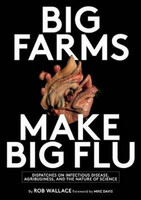
Big Farms Make Big Flu

No reviews yet Write a Review
Paperback / softback
1 June 2016
400 Pages
$62.99
Ships in 4-6 business days
Hurry up! Current stock:

Thanks to breakthroughs in production and food science, agribusiness has been able to devise new ways to grow more food and get it more places more quickly. There is no shortage of news items on hundreds of thousands of hybrid poultry - each animal genetically identical to the next - packed together in megabarns, grown out in a matter of months, then slaughtered, processed and shipped to the other side of the globe. Less well known are the deadly pathogens mutating in, and emerging out of, these specialized agro-environments. In fact, many of the most dangerous new diseases in humans can be traced back to such food systems, among them Campylobacter, Nipah virus, Q fever, hepatitis E, and a variety of novel influenza variants. Agribusiness has known for decades that packing thousands of birds or livestock together results in a monoculture that selects for such disease. But market economics doesnt punish the companies for growing Big Flu - it punishes animals, the environment, consumers, and contract farmers. Alongside growing profits, diseases are permitted to emerge, evolve, and spread with little check. "That is," writes evolutionary biologist Rob Wallace, "it pays to produce a pathogen that could kill a billion people."

In Big Farms Make Big Flu, a collection of dispatches by turns harrowing and thought-provoking, Wallace tracks the ways influenza and other pathogens emerge from an agriculture controlled by multinational corporations. Wallace details, with a precise and radical wit, the latest in the science of agricultural epidemiology, while at the same time juxtaposing ghastly phenomena such as attempts at producing featherless chickens, microbial time travel, and neoliberal Ebola. Wallace also offers sensible alternatives to lethal agribusiness. Some, such as farming cooperatives, integrated pathogen management, and mixed crop-livestock systems, are already in practice off the agribusiness grid.While many books cover facets of food or outbreaks, Wallaces collection appears the first to explore infectious disease, agriculture, economics and the nature of science together. Big Farms Make Big Flu integrates the political economies of disease and science to derive a new understanding of the evolution of infections. Highly capitalized agriculture may be farming pathogens as much as chickens or corn.

Book details

ISBN-13
9781583675892
Author
Rob Wallace
Publisher
NEW YORK UNIVERSITY PRESS
Published
1 June 2016
Format
Paperback / softback
Pages
400

You Can Find This Book In

    This Book Is Categorised By

    This product hasn't received any reviews yet. Be the first to review this product!

    $62.99
    Ships in 4-6 business days
    Hurry up! Current stock:

    Big Farms Make Big Flu

    $62.99

    Description

    Thanks to breakthroughs in production and food science, agribusiness has been able to devise new ways to grow more food and get it more places more quickly. There is no shortage of news items on hundreds of thousands of hybrid poultry - each animal genetically identical to the next - packed together in megabarns, grown out in a matter of months, then slaughtered, processed and shipped to the other side of the globe. Less well known are the deadly pathogens mutating in, and emerging out of, these specialized agro-environments. In fact, many of the most dangerous new diseases in humans can be traced back to such food systems, among them Campylobacter, Nipah virus, Q fever, hepatitis E, and a variety of novel influenza variants. Agribusiness has known for decades that packing thousands of birds or livestock together results in a monoculture that selects for such disease. But market economics doesnt punish the companies for growing Big Flu - it punishes animals, the environment, consumers, and contract farmers. Alongside growing profits, diseases are permitted to emerge, evolve, and spread with little check. "That is," writes evolutionary biologist Rob Wallace, "it pays to produce a pathogen that could kill a billion people."

    In Big Farms Make Big Flu, a collection of dispatches by turns harrowing and thought-provoking, Wallace tracks the ways influenza and other pathogens emerge from an agriculture controlled by multinational corporations. Wallace details, with a precise and radical wit, the latest in the science of agricultural epidemiology, while at the same time juxtaposing ghastly phenomena such as attempts at producing featherless chickens, microbial time travel, and neoliberal Ebola. Wallace also offers sensible alternatives to lethal agribusiness. Some, such as farming cooperatives, integrated pathogen management, and mixed crop-livestock systems, are already in practice off the agribusiness grid.While many books cover facets of food or outbreaks, Wallaces collection appears the first to explore infectious disease, agriculture, economics and the nature of science together. Big Farms Make Big Flu integrates the political economies of disease and science to derive a new understanding of the evolution of infections. Highly capitalized agriculture may be farming pathogens as much as chickens or corn.

    Book details

    ISBN-13
    9781583675892
    Author
    Rob Wallace
    Publisher
    NEW YORK UNIVERSITY PRESS
    Published
    1 June 2016
    Format
    Paperback / softback
    Pages
    400

    You Can Find This Book In

      This Book Is Categorised By