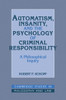
Automatism, Insanity, and the Psychology of Criminal Responsibility
This is a book about the role that psychological impairment should play in a theory of criminal liability. Criminal guilt in the Anglo-American legal tradition requires both that the defendant committed some proscribed act and did so with intent, knowledge, or recklessness. The second requirement corresponds to the intuitive idea that people should not be punished for something they did not do 'on purpose' or if they 'did not realize what they were doing'. Unlike many works in this area, this book addresses the automatism and insanity defences by examining the types of functional impairment that typical candidates for these defences actually suffer. What emerges is a much wider conceptual framework that allows us to understand the significance of psychological states and processes for the attribution of criminal responsibility in a manner that is logically coherent, morally defensible, and consistent with research in psychopathology.
On Insanity and the Criminal Responsibility of the Insane is a historical text by Thomas More Madden. The book covers the legal and medical aspects of insanity and criminal responsibility in the late...
This work has been selected by scholars as being culturally important, and is part of the knowledge base of civilization as we know it. This work was reproduced from the original artifact, and...
The Making of the Modern Law: Legal Treatises, 1800-1926 includes over 20,000 analytical, theoretical and practical works on American and British Law. It includes the writings of major legal...
This book analyzes the legal doctrine of responsibility in cases of insanity related to criminal acts. It presents a comprehensive study on how to handle such instances while still maintaining the...
The Making of the Modern Law: Legal Treatises, 1800-1926 includes over 20,000 analytical, theoretical and practical works on American and British Law. It includes the writings of major legal...