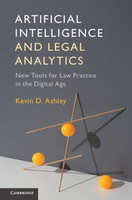

The field of artificial intelligence (AI) and the law is on the cusp of a revolution that began with text analytic programs like IBM's Watson and Debater and the open-source information management architectures on which they are based. Today, new legal applications are beginning to appear and this book - designed to explain computational processes to non-programmers - describes how they will change the practice of law, specifically by connecting computational models of legal reasoning directly with legal text, generating arguments for and against particular outcomes, predicting outcomes and explaining these predictions with reasons that legal professionals will be able to evaluate for themselves. These legal applications will support conceptual legal information retrieval and allow cognitive computing, enabling a collaboration between humans and computers in which each does what it can do best. Anyone interested in how AI is changing the practice of law should read this illuminating work.
How are new technologies changing the practice of law?
With examples and explanations drawn from the UK, US, Canada, Australia and other common law countries, as well as from China and Europe, this...
A class of highly mathematical algorithms works with three-dimensional (3D) data known as graphs. Our research challenge focuses on applying these algorithms to solve more complex problems with...
The mission of the book is to prepare current and future data science and software engineering teams with the skills to fully utilize advanced data science to develop agricultural software...